

Understanding UDI and identifiers
Learn about each type of identifier required under the Australian UDI framework
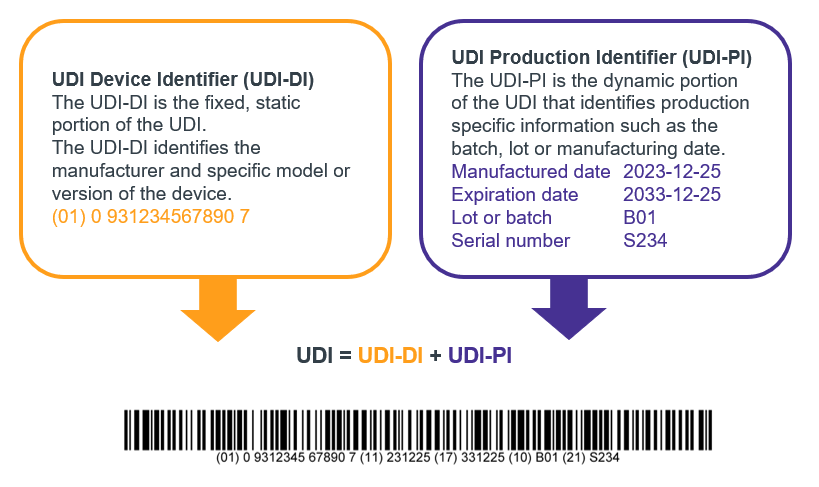
A UDI identifies a specific model and production run of a medical device.
It has 2 parts:
- UDI Device Identifier (UDI-DI)
- UDI Production Identifier (UDI-PI).
The full UDI links a model to its production run and is used to trace the model of device down to the batch, lot or manufacturing date.
If a recall affects one production run, the UDI-DI identifies the model, and the UDI-PI identifies the affected batch.
UDI-Device Identifier (UDI-DI)
The UDI-DI is a globally unique numeric or alphanumeric code that identifies the device model.
The UDI-DI must appear on the device label, packaging, and in some cases on the device itself. It is also submitted to the AusUDID as the ‘Primary DI’.
The image below shows the UDI-DI portion of a UDI.

UDI-Production Identifier (UDI-PI)
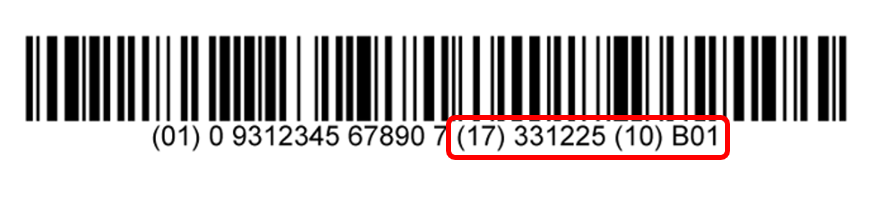
The UDI-PI identifies production details such as batch, lot, software version or manufacturing date.
The UDI-PI must appear on the device label, packaging, and in some cases on the device itself. However, the UDI-PI is not stored in the AusUDID.
The image below shows the UDI-PI portion of the UDI.
Primary DI
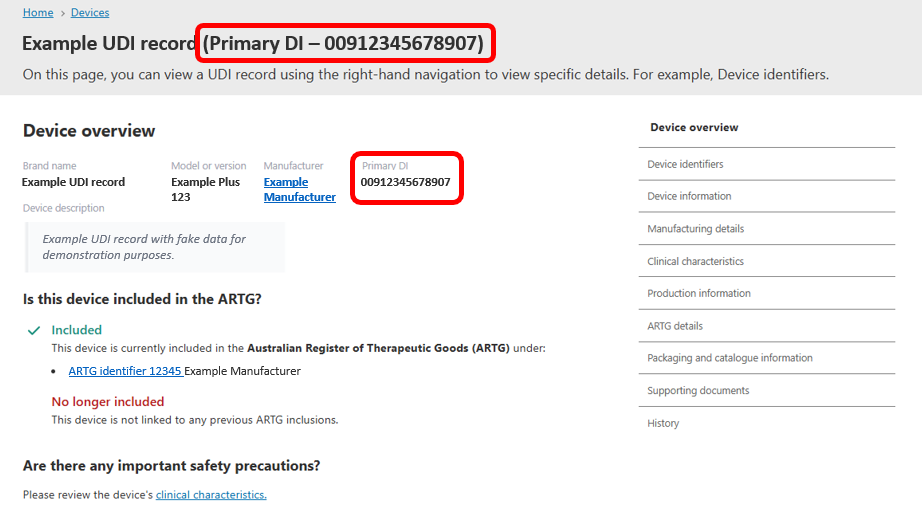
The Primary DI is not an additional identifier - it is synonymous with the UDI-DI. It is referred to as the Primary DI in the AusUDID, as it is the primary lookup value.
The Primary DI is the UDI-DI portion of the UDI applied to the lowest level of packaging of a device.
The images below show how the UDI-DI and Primary DI are the same.
Direct Marking DI
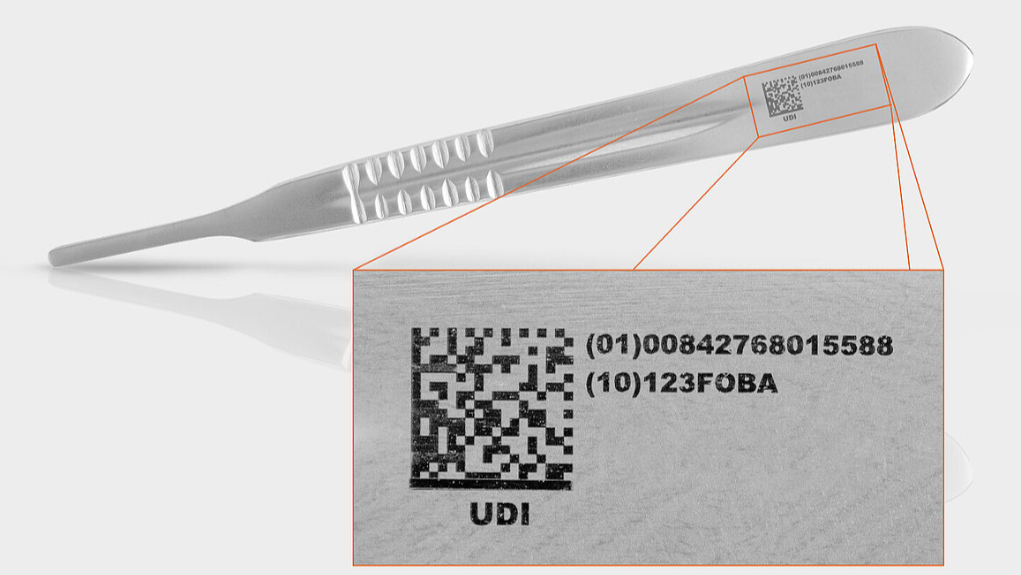
Some devices are required to have the UDI directly marked onto the device itself. The UDI permanently marked on the device is referred to as the Direct Marking DI. The Direct Marking DI ensures reusable devices remain identifiable after it is removed from its packaging or the label is removed.
It may match or differ from the UDI-DI on the label.
Example:
A reusable surgical instrument must have the UDI directly marked onto the device itself. The UDI engraved, etched or marked onto the device is the Direct Marking DI. It may be the same as the UDI on the device label, or it may be different.
Unit of Use DI
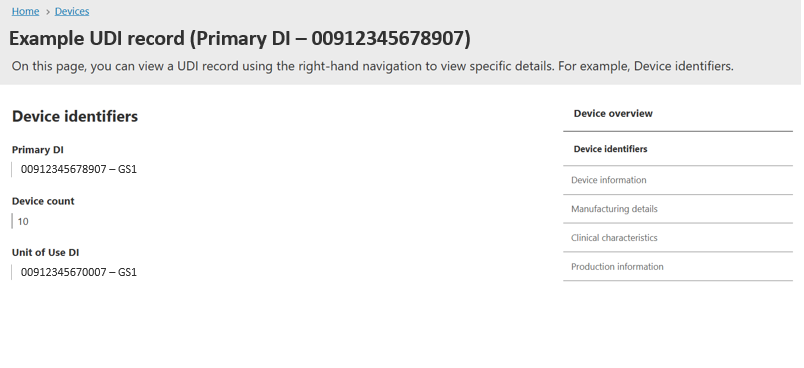
If a base package contains multiple instances of the same model of device and the devices are not individually labelled with a UDI, the devices must be allocated a Unit of Use DI. This identifier is virtual. It does not appear on the label, packaging, or the device but it must be provided in the UDI record in the AusUDID.
The image below shows how the Unit of Use DI is included in a UDI record.


Package DI
Package DI(s) are UDIs applied to packaging levels above the base package. They follow standard UDI requirements, and they are submitted to the AusUDID as Package DI(s).
Package DIs help find devices when multiple packaging levels exist between the device and the outer carton(s).
Example:
A base package contains one medical device. A box contains 5 base packages. A carton contains 5 boxes. A Package DI must be allocated to the box and the carton. If the carton is used for shipping purposes only, it is considered a logistics unit and is exempt from UDI requirements.
Secondary DI
You are not required to allocate more than one UDI-DI to a model of device. However, in some cases, devices may be allocated with a UDI-DI from more than one Issuing Agency. The Secondary DI enables identification of the device using any of these identifiers.
While the Primary UDI-DI is the only UDI-DI on the label, you may include the Secondary DI in your UDI record and support scenarios when the Secondary DI is used.
Example:
A device bears a HIBCC UDI-DI but is also supplied through GS1’s National Product Catalogue. Because of this, the device will also be allocated a GS1 UDI-DI. Both UDI-DIs can be submitted in the UDI record, with the UDI-DI on the label must be submitted as the Primary DI. If a hospital’s inventory management system refers to the GS1 allocated UDI-DI, the device can still be identified and located.
Previous DI
A Previous DI allows for the identification of a device that was assigned a new or substitute device identifier for reasons other than changes to the device physical specifications or new indications for use that changed the version or model.
When a device changes in a way that triggers a new UDI-DI, the Australian UDI requirements stipulate that you create a new UDI record. The Previous DI provides a means to link the 2 UDIs via 2 records in the AusUDID.
Example:
A device’s brand name changes, which is a UDI Trigger, and a new UDI-DI must be assigned to the device with the new brand name. A new UDI record must be created for the new UDI-DI and the Previous DI will allow linking of the 2 UDI records, showing the relationship between the different brand-named devices.
Summary of identifiers
The below table summarises the various identifiers, their use and whether they are included in the AusUDID.
| Identifier | Purpose | Required on label? | Required in the AusUDID? |
|---|---|---|---|
| UDI-DI | Identifies device model | Yes | Yes |
| UDI-PI | Identifies production run of the device | Yes | No |
| Direct Marking DI | Identifies reusable devices when separated from their packaging | Required on the device itself | Yes |
| Unit of Use DI | Identifies devices at unit-of-use level | No | Yes |
| Package DI | Identifies device at higher packaging levels | Required on packaging | Yes |
| Secondary DI | Additional UDI-DI | No | Optional |
| Previous DI | Links old and new UDI records | No | Optional |
Page history
Original publication
Original publication