

UDI labelling and packaging requirements
Understand and apply the UDI labelling and packaging requirements to your medical devices.
As a manufacturer, you must apply a UDI to:
- the device label
- the device itself, if direct marking applies
- all applicable higher levels of packaging
- Patient Implant Cards (PICs), if applicable.
UDIs are applied in the form of a UDI Carrier.
UDI Carrier
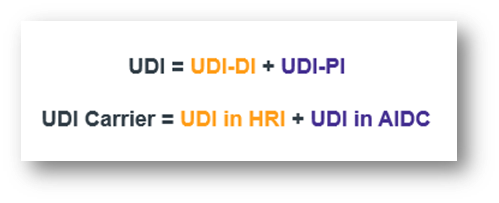
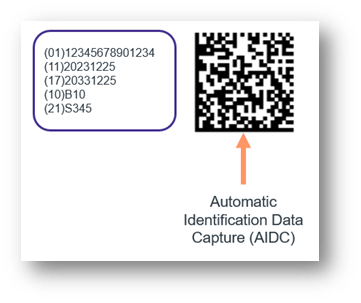
The UDI Carrier is the physical means to convey the UDI. The UDI Carrier displays the full UDI (UDI-DI and UDI-PI) in 2 forms:
- Human Readable Interpretation (HRI)
- Automatic Identification Data Capture (AIDC).
This is to ensure the device can be both read by humans and machines.
The image below demonstrates how the UDI-DI plus the UDI-PI form the full UDI, and how the full UDI in HRI and AIDC form the UDI Carrier.
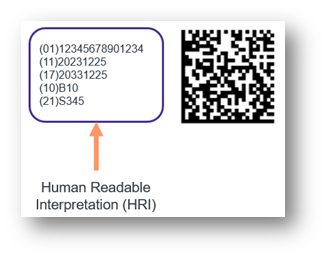
Human Readable Interpretation (HRI)
The HRI form is a legible version of the data encoded in the UDI Carrier. It is typically placed next to or below the AIDC form. This form allows for the UDI to be captured manually when the AIDC form cannot be captured.
In the HRI form:
- list the UDI-DI first, followed by the UDI-PI, including HRI data delimiters
- include any non-UDI elements after the UDI-PI, if applicable.
HRI data delimiters
The HRI portion of the UDI Carrier must include data delimiters, unless exempt*. These may also be known as qualifiers or application identifiers.
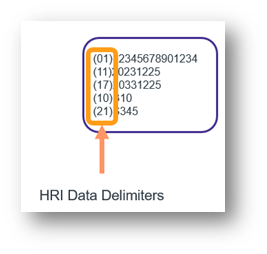
Data delimiters help to:
- distinguish the information in the UDI
- access the encoded data in case of damaged or unreadable AIDC forms.
Data delimiters vary between Issuing Agencies. Your chosen Issuing Agency can provide guidance on the correct data delimiters and formatting.
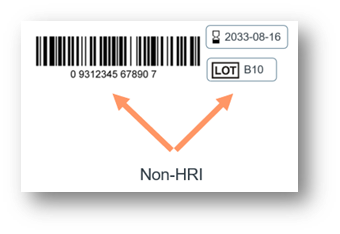
Non-HRI
Non-HRI refers to human-readable formats that are not structured as HRI, such as plain text. Devices principally sold in retail do not require the UDI in HRI. Instead, they can display the UDI in a non-HRI or plain text format.
Because HRI is not required for these devices, HRI data delimiters are also not required.
Automatic Identification and Data Capture (AIDC)
We do not restrict AIDC to a specific symbology, recognising that different formats may suit different settings and use. Acceptable AIDC technologies include:
- linear barcodes (1D)
- data matrix barcodes (2D)
- smart cards, biometrics
- Radio Frequency Identification (RFID).
If you use RFID technology, you must:
- comply with open and commercially acceptable, international standards such as ISO/IEC 17360:2023, and
- also provide a linear, 2D barcode or another type of barcode on the label to maintain usability for systems with varying technological capabilities.
If you use linear bar codes, you may present the UDI-DI and UDI-PI as either:
- concatenated (combined) barcodes
- non-concatenated (separate) barcodes.
Regardless of format, all elements must be clearly distinguishable and identifiable.
While non-concatenated barcodes are acceptable under UDI regulations, they may cause confusion for end users. Manufacturers must decide whether concatenated or non-concatenated are more appropriate.
Issuing Agencies may recommend specific formats, such as 2D data matrix over linear barcodes. You must consult with your chosen Issuing Agency to confirm the appropriate format for your device.
UDI Carrier placement
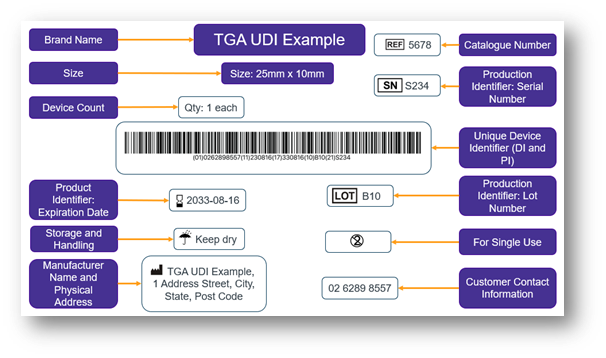
As a manufacturer, you are responsible for placing the UDI Carrier on the device label and all applicable higher levels of packaging. You must also determine the most appropriate placement of the UDI Carrier. It should be positioned so that the AIDC format is accessible during normal use or storage.
If the device is subject to direct marking requirements, the UDI Carrier must be directly marked onto the device itself, unless exempt.
Each Issuing Agency provides its own technical specifications for UDI Carriers, including:
- type
- size
- placement
- quality.
As a manufacturer, you should consult your chosen Issuing Agency to select the most appropriate UDI Carrier.
Multiple barcodes on a single label
We recommend you avoid placing multiple barcodes on a label.
If a label contains multiple barcodes, you should ensure that consumers and healthcare can easily distinguish the UDI Carrier from other barcodes.
We recommend the use of UDI ISO symbol (ISO 15223-1, UDI Graphical Symbol 5.7.10, 2021) to assist the identification of the UDI.

If your device is packaged with a medicine and bears medicine serialisation, we recommend you use the UDI ISO symbol to clearly distinguish the UDI.
Exemptions for UDI Carrier
Significant space constraints limiting the use of HRI or AIDC
If there are significant constraints that prevent the use of both AIDC and HRI on the label, you should prioritise the AIDC form. However, in certain environments, such as home care, HRI may be more appropriate than AIDC. It is the manufacturer’s responsibility to determine which form is best suited.
The manufacturer is responsible for determining whether the constraints are significant and limit the use of both HRI and AIDC. You may be required to justify this decision to the TGA, when requested.
Significant space constraints limiting the UDI Carrier being applied to the base package
If there are significant constraints that prevent the UDI Carrier being applied to the base package, it is acceptable to apply the UDI to the next higher level of packaging.
The manufacturer is responsible for determining whether the constraints are significant and limit the application of the UDI on the base package. You may be required to justify this decision to the TGA, when requested.
Devices principally sold in retail
Devices that are principally sold in retail are not exempt from UDI requirements. However, these devices have reduced labelling requirements.
For more information on devices principally sold in retail, see Complying with the Unique Device Identification requirements for medical devices.
Packaging levels
To allow the device to be tracked throughout the supply chain, UDIs must be applied to every applicable level of packaging across every packaging configuration. The UDI-DI on the base package is referred to as the Primary DI, and all other UDI-DIs on packaging levels are Package DIs.
The Package DI allows for all packages containing a specific device to be easily identified when in storage.
Applicable packaging levels
Applicable levels of packaging include:
- the base package
- secondary package
- tertiary package
- any additional higher levels of packaging.
Logistics or shipping units are not applicable levels of packaging. These units do not require a Package DI; however, you may choose to apply one.
Examples of logistics units that do not need a Package DI include:
- shipping units
- Shelf Ready Packaging (SRP) used as advertising
- cartons used only for shipping
- shipping invoices
- any other form of shipper.
Base package
The base package is the lowest level of the device packaging. It is typically the smallest package distributed commercially. Sometimes, it is the only packaging and may be called the base unit or ‘each’.
If there are significant constraints that prevent the UDI Carrier being applied to the base package, it is acceptable to apply the UDI to the next higher level of packaging, which is then considered the base package from the perspective of UDI.
The Primary DI is assigned to the Base Package.
If the base package contains more than one unpackaged and unlabelled instance of the device, you must also allocate a Unit of Use DI, unless otherwise exempt.
Secondary, tertiary and additional packaging levels
Packaging levels above the base package can be referred to as ‘Secondary’ and ‘Tertiary’ packages.
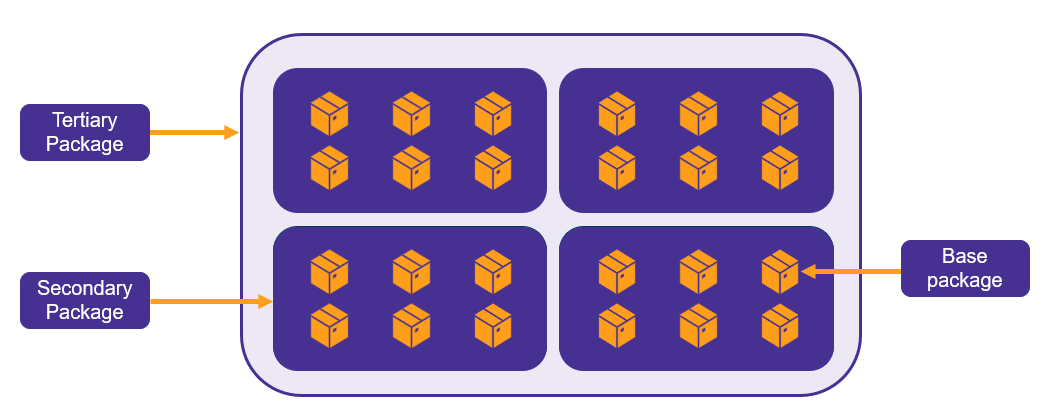
Secondary packages contain a set number of base packages. Tertiary packages contain a set number of secondary packages. Additional packaging levels are any above tertiary.
The example below shows how these levels may appear in a packaging configuration.
Applying UDIs to packaging levels
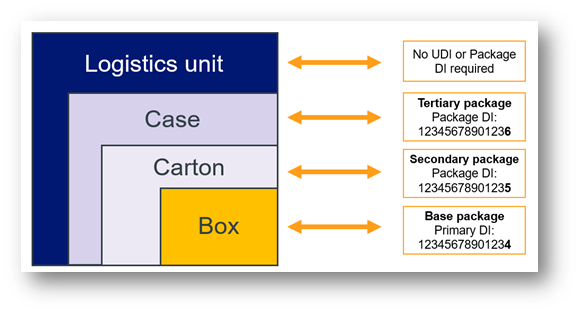
Each packaging level is allocated its own full UDI. The UDI-DI on the base package is the Primary DI, and the UDI-DI on higher levels of packaging is the Package DI. Every Package DI must be unique to the level of packaging.
The example below shows the relationship between different packaging levels, UDI requirements at each level, and how each UDI-DI is unique.
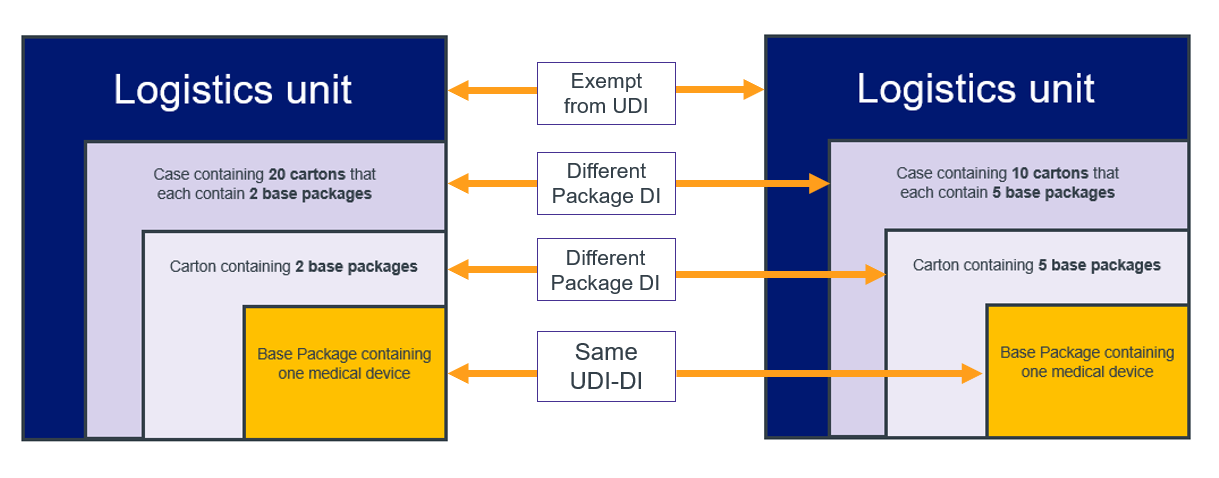
Where a device is supplied in multiple configurations, a unique Package DI must be applied to each packaging level for each packaging configuration.
In the example below, there would be one Primary UDI-DI and 2 packaging configurations representing the different packaging options.
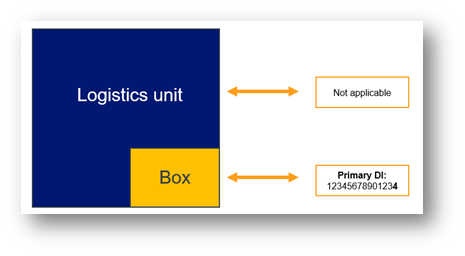
Where the base package is the only packaging level, no Package DIs are required. The below image shows how a device may be packaged that does not require Package DIs.
Examples of UDI on packaging
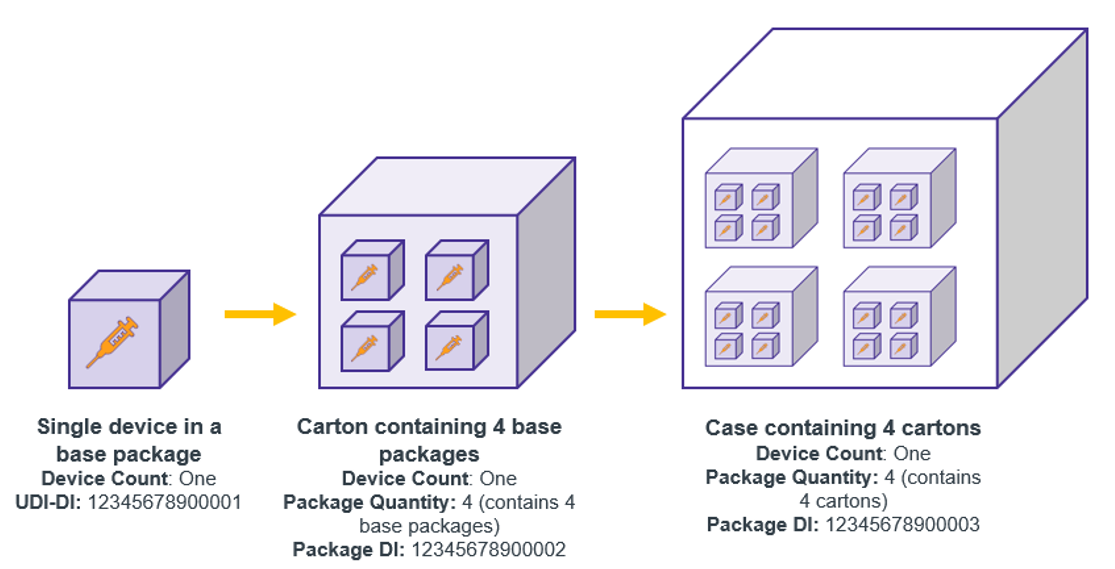
The image below shows a syringe with 3 packaging levels:
- Base package: One syringe with UDI-DI 12345678900001.
- Secondary package: Carton with 4 base packages, with Package DI 12345678900002.
- Tertiary package: Case with 4 cartons (each with 4 syringes), with Package DI 12345678900003.
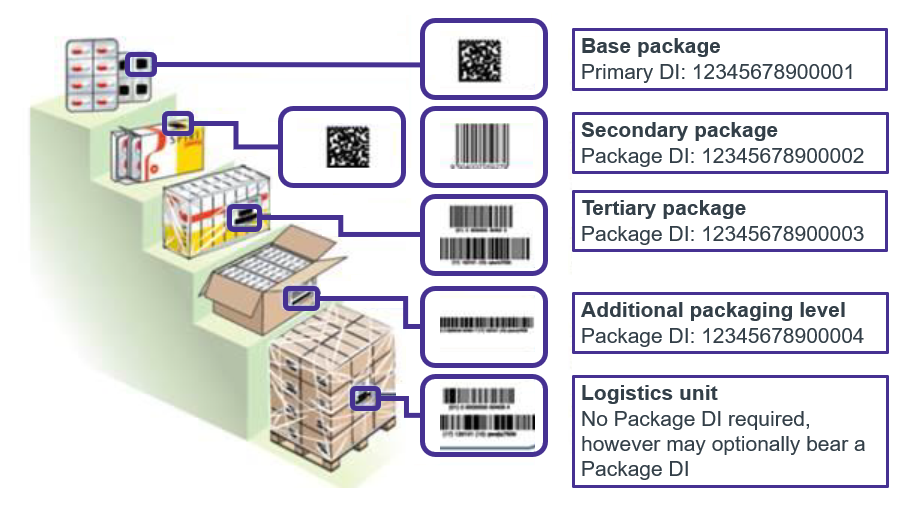
The image below shows how a unique UDI is applied to each level of packaging using GS1 issued identifiers.
In this example:
- Primary DI 12345678900001 is the base package UDI-DI or Primary DI
- The higher levels of packaging have unique GTINS representing the Package DIs for each level.
Packaging level data in the Australian UDI Database
The UDI-DI on the base package is submitted in the UDI record as the ‘Primary DI’.
Where your device has higher levels of packaging that must bear a UDI, the UDI-DIs on the higher levels of packaging are submitted in the UDI record as a ‘Package DI’.
The image below shows how packaging information displays in a UDI record the AusUDID. The Primary DI on the device label is 12345678900001 and 5 of these devices are supplied in a box that has the Package DI of 12345678900002 on the label.
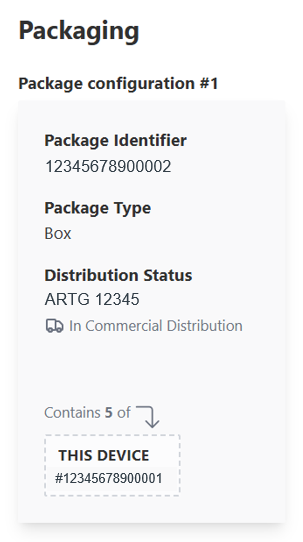
If your device has no higher packaging levels, you do not need to allocate a Package DI or submit packaging information to the AusUDID.
In the circumstance where there are multiple sponsors for a medical device that bears the same UDI, packaging configurations may differ for each sponsor. The manufacturer should still allocate the UDI for the device and all applicable levels of device packaging.
As a sponsor, if you choose to distribute your devices in different packaging configurations, you must obtain the Package DIs from the manufacturer, apply them to each applicable level of packaging and provide the Package DIs in your UDI record.
Retail packaging
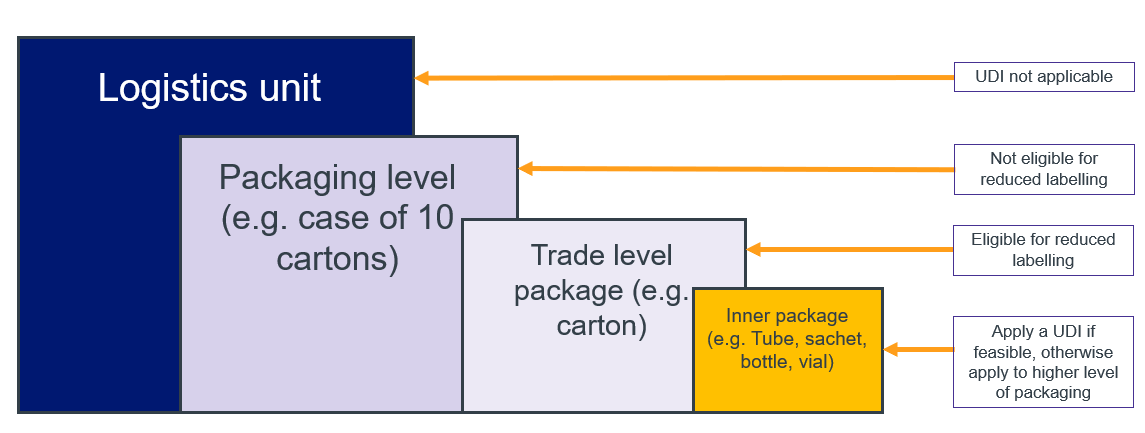
Devices principally sold in retail premises have reduced labelling requirements. These devices:
- can have reduced labelling on the trade level of packaging, which is generally considered the level of packaging that is consumer-facing
- must have full UDI-compliant labelling on any other levels of packaging, including secondary and tertiary packaging levels.
As with devices supplied to healthcare, devices principally sold in retail premises:
- do not require UDI on Shelf Ready Packaging (SRP)
- do not require UDI on logistics units, as logistics units are not required to meet UDI requirements.
The image below shows how UDI applies to different levels of retail packaging.
Direct marking
Direct marking permanently applies a UDI to the device itself. The UDI that is directly marked is called the Direct Marking DI.
Direct marking helps identify reusable devices when they are no longer accompanied by packaging or labels.
As a manufacturer, you must directly mark the full UDI on the device if it:
- is reusable, and
- is reprocessed between use on different patients.
It must withstand the normal use and cleaning for the device’s lifetime.
Applying the label directly to the device or printing the label directly onto the device will meet the UDI labelling requirements however this is not referred to as direct marking.
Direct marking applies when the device requires permanent marking on the device, if the label cannot withstand the reprocessing of the device. If the label will not be damaged by the cleaning of the device through its lifetime, direct marking is not required. For example, capital equipment such as a MRI machine could have the UDI label affixed to the machine as a sticker or metal plate; it does not need the UDI directly marked if the label will remain intact after the intended cleaning that takes place over the life of the device.
While you are expected to label these devices with a UDI (unless otherwise exempt); the ‘direct marking’ requirements do not apply.
For more information on capital equipment, see Complying with the Unique Device Identification requirements for medical devices.
Direct marking placement
We do not specify how or where you directly mark your device. There are many options available for direct marking of devices. Your chosen Issuing Agency can give you recommendations on aspects of direct marking, considering factors such as:
- substrate requirements
- dimensions
- quality
- placement
- suitable methods.
As a manufacturer, you are responsible for:
- selecting the direct marking method
- ensuring the directly marked UDI can withstand normal use and cleaning procedures for the device’s lifetime.
If there are significant constraints limiting the direct marking of both AIDC and HRI on the device, the AIDC form is favoured. However, you should consider the environments or use situations for the device. For example, home care use may warrant the use of HRI over AIDC. As a manufacturer, it is your responsibility to give your reasoning for the direct marking form selected, when requested by us.
A Direct Marking DI can be the same or different to the UDI-DI on the base package (Primary DI). As a manufacturer, it is your responsibility to decide if you wish to make this distinction. As the sponsor, it is your responsibility to ensure the data in the AusUDID reflects this decision.
Cases where the direct marking UDI-DI may be different to the UDI-DI for a device include where a device is:
- packaged in both single and multiple packs
- provided both in sterile and non-sterile packaging
- provided in different sizes which are sold together.
Direct marking exemptions
Direct marking exemptions apply for:
- devices that are reprocessed between uses on the same patient*
- implantable devices
- devices where any type of direct marking would interfere with the safety or performance or effectiveness of the device
- devices where it is not technically feasible to directly mark the device
- devices that are manufactured and labelled prior to the direct marking compliance date for the device.
*If the device is subsequently reprocessed for use on another patient, the direct marking exemption does not apply.
When a medical device is exempt from direct marking, the UDI must be on the next level of packaging.
As a manufacturer, it is your responsibility to give your reasoning for not meeting the direct marking requirements, when requested by us.
You may not be required to directly mark capital equipment. However, you are required to meet UDI labelling requirements for these devices.
Devices that you manufacture and label before their direct marking mandatory compliance dates are exempt from direct marking requirements for the lifetime of the device.
Unit of Use
The Unit of Use Device Identifier (Unit of Use DI) is a virtual identifier allocated to an individual medical device when:
- you supply more than one of the same device in a base package, making the device count in the base package greater than one, and
- you are unable to label or directly mark the individual devices in the base package.
The purpose of the Unit of Use is to associate the use of a device to or on a patient when a base package contains more than one of the same device.
The image below shows how a Unit of Use DI is allocated to devices below the base package. Note that all devices below the base package level are the same and therefore share the same Unit of Use DI. That is, you do not allocate a different Unit of Use DI to each individual item within the base package.
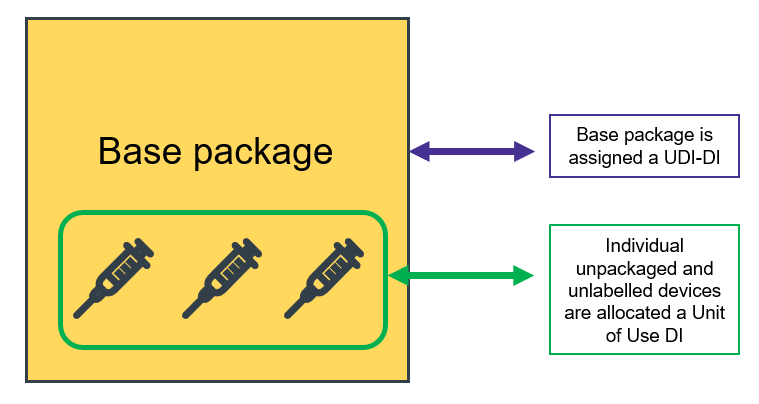
The Unit of Use DI is not the Primary DI, as it does not replace the UDI-DI for the base package. The UDI-DI applied to the base package remains the Primary DI, even when a Unit of Use DI is allocated. However, the Unit of Use DI allows distinction between the individual device and the grouping at the base package level. In healthcare, there may be clinical reasons why the tracking of individual items is necessary.
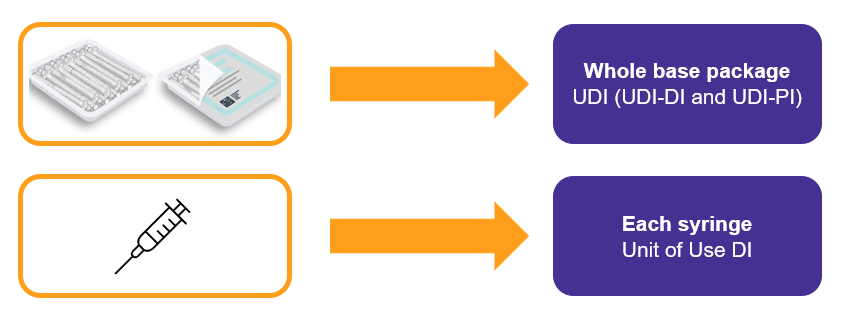
Though the Unit of Use DI is used to identify devices below the base package, the Unit of Use DI is a ‘Virtual UDI’, meaning you do not need to label your devices or device packaging with the Unit of Use DI. However, you must enter the Unit of Use DI in the AusUDID, allowing traceability back to the Primary DI. The Unit of Use DI must follow the UDI rules of the Issuing Agency chosen by the manufacturer for the Primary DI.
The table below further explains:
- the device identifier required for each packaging level
- whether you must apply the device identifier to the label
- whether you must supply the device identifier to the AusUDID.
| Unit of measure (packaging level) | Quantity | Device Identifier | Applied to device package or label? | Supplied to AusUDID? |
|---|---|---|---|---|
| Single item | 1 single item | Unit of Use DI | No | Yes |
| Base package | 10 single items | UDI-DI, or Primary DI | Yes | Yes |
| Secondary package | 50 base packages | Package DI | Yes | Yes |
| Tertiary package | 500 cartons | Package DI | Yes | Yes |
Unit of Use DI can be the same for multiple packages
As the same device can be present in more than one base package, a Unit of Use DI can be associated with more than one base package with different Primary DIs.
For example, if the same syringe is packed into 2 different box configurations where one box contains 20 syringes and another box contains 100, each box would have a different Primary DI; however, the Unit of Use DI, identifying the actual syringe, can be the same. The image below demonstrates how the Unit of Use DI can be the same when the Primary DI and Package DIs differ.
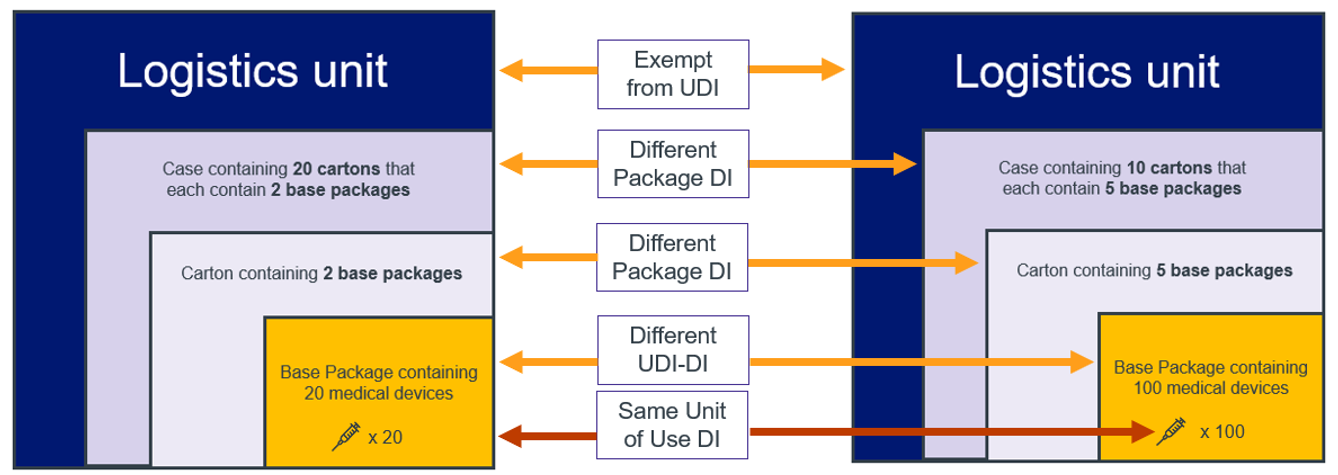


Unit of Use examples
Sam the manufacturer and sponsor
Sam manufacturers a tray of 25 of the same syringes. The devices within the tray cannot be individually packaged or labelled.
In this scenario:
- the tray is the base package and allocated a UDI-DI
- a UDI Carrier is applied to the base package
- the syringes in the tray are allocated a Unit of Use DI
- all the syringes share the same Unit of Use DI
- the Unit of Use DI is virtual and is not applied to the syringes or the tray.
When submitting the UDI record, Sam records:
- the UDI-DI from the base package as the Primary DI
- the Unit of Use DI allocated to the individual devices as the Unit of Use DI
- the Device Count of the base package, which in this instance is 25.
Mary the manufacturer and sponsor
Mary manufactures a box of 5 of the same scalpels. The scalpels are not individually labelled so the box represents the base package. Mary applies a UDI Carrier to the box. The UDI Carrier contains the UDI-DI and the UDI-PI. The UDI-DI of the UDI Carrier applied to the box is the Primary DI.
Because Mary’s scalpels are reusable, Mary has also directly marked her devices with a Direct Marked DI. Because Mary has directly marked her devices, she does not need to allocate a Unit of Use DI.
If Mary directly marked her devices with the Primary DI (same as the base package), Mary does not need to enter it in the AusUDID as the Direct Marking DI or Unit of Use DI. Mary does need to select ‘No’ for the ‘Direct Marking DI Different from Primary DI?’ field in the AusUDID.
If Mary choses to distinguish the individual scalpels from the base package and provide a specific Direct Marked DI, Mary must select ‘Yes’ for the ‘Direct Marking DI Different from Primary DI?’ field and provide the Direct Marked DI to the AusUDID.
It is Mary’s responsibility to decide if she makes this distinction. manufacturers a tray of 25 of the same syringes. The devices within the tray cannot be individually packaged or labelled.
Unit of Use exemptions
Some specific types of medical device are exempt from Unit of Use requirements.
Devices intended for a single patient or user
When the UDI is applied to a package containing multiple devices of the same model or version, generally the manufacturer must allocate a Unit of Use DI. However, where all devices are intended for use on or by the same patient and intended to remain in the package until use, Unit of Use is optional because it is assumed the patient or user will consume all the devices.
This includes devices principally sold in retail, as it is expected that all devices within the base package will be used by the same user, and as such, the Unit of Use DI is not required to link usage to a patient.
Kits
Unit of Use requirements do not apply to any kind of kit, as kits are a collection of different devices rather than the same device. Unit of Use DI is specifically intended for situations where multiple identical devices are packaged together and the individual items are not labelled with a UDI.
System or Procedure Packs (SOPPs)
Unit of Use requirements do not apply to SOPPs, as SOPPs are treated as a single device.
Page history
- Changed title of page from 'UDI labelling requirements' to 'UDI labelling and packaging requirements'.
- Clarified packaging terminology including 'base package'
- Included information on labelling and packaging for devices principally sold in retail
- Included information on packaging information in a UDI record
- Provided additional examples of Unit of Use, Packaging, and labelling.
Original publication.
- Changed title of page from 'UDI labelling requirements' to 'UDI labelling and packaging requirements'.
- Clarified packaging terminology including 'base package'
- Included information on labelling and packaging for devices principally sold in retail
- Included information on packaging information in a UDI record
- Provided additional examples of Unit of Use, Packaging, and labelling.
Original publication.