

Understanding UDIs and related healthcare identifiers
Understand UDIs, Unit of Use DIs, Direct Marking DIs, and other identifiers used in the Australian UDI framework and how they relate to identifiers already used in healthcare, procurement, inventory and billing systems.
There are a range of identifiers used in the Australian UDI framework.
Unique Device Identifiers (UDIs)
A UDI is a globally unique series of numeric or alphanumeric characters assigned to a medical device. UDIs are issued using internationally recognised standards managed by organisations known as Issuing Agencies. Australia recognises 3 Issuing Agencies:
- GS1
- Health Industry Business Communications Council (HIBCC)
- International Council for Commonality in Blood Banking Automation (ICCBBA).
A UDI consists of 2 components:
- UDI-Device Identifier (UDI-DI), the fixed component that identifies a specific model or version of a medical device
- UDI-Production Identifier (UDI-PI), the variable component that provides production information about a device, such as a batch number, lot number, serial number, manufacturing date, expiry date or software version.
Figure 1: Example of a UDI-DI and UDI-PI
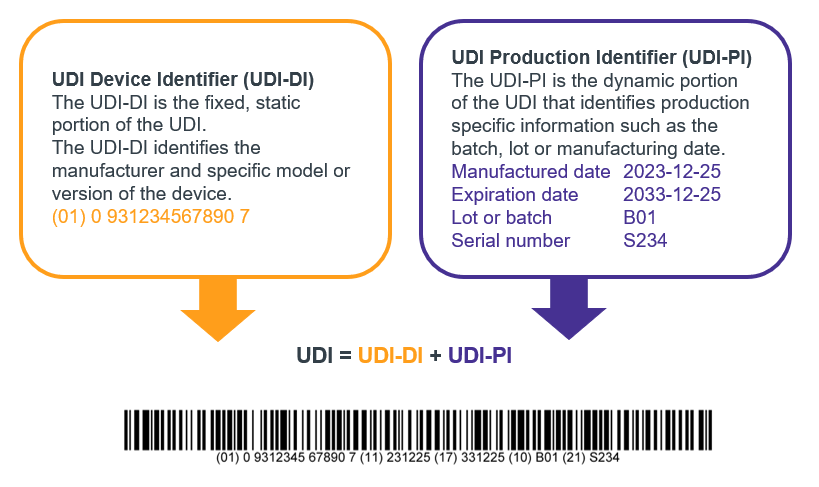

An example of a UDI shown in a linear barcode. The UDI-DI and UDI-PI are combined to form the full UDI.
The UDI is the fixed, static portion of the UDI. The UDI-PI is the dynamic portion of the UDI that identifies production information such as batch number or manufacturing date.
The UDI-DI links to information stored in the Australian UDI Database (AusUDID), while the UDI-PI identifies the specific production details of an individual device or production run. Together, these identifiers support accurate device identification, traceability and patient safety.
Every device subject to UDI requirements must have a UDI-DI. Depending on the type of device, the UDI-PI may contain one or more production identifiers.
Unit of Use DI
A Unit of Use Device Identifier (Unit of Use DI) is assigned when multiple unlabelled devices are supplied within a single package. It provides a way to identify an individual device when the device itself does not carry its own UDI label.
For example, a tray containing 25 syringes may have a UDI assigned to the tray and a separate Unit of Use DI assigned to each individual syringe. The Unit of Use DI assigned to the syringes is the same for each syringe, but different to the UDI assigned to the tray.
This supports identification of the device used for a patient, even when the individual device is not labelled.
The Unit of Use DI is recorded in the AusUDID but is not required to be labelled on the individual device or packaging. Because of this, healthcare providers will not see the Unit of Use DI on devices themselves.
Direct Marking DI
Reusable medical devices that are reprocessed between uses on different patients must be directly marked with the UDI. This is to support ongoing identification, even where the device is separated from its packaging.
Direct marking helps ensure the device remains identifiable throughout its working life and after repeated reprocessing.
Examples of direct marking include laser etching and engraving.
Direct marking is not required for:
- implantable devices
- devices where direct marking is not technologically feasible
- devices where direct marking may affect safety or performance.
Capital equipment, such as an MRI machine, is not required to be directly marked, however it must bear the UDI via means such as durable labels or metal plates.
Using UDIs
UDI provides a common identifier that can be used throughout the lifecycle of a medical device. Different stakeholders use UDI information for different purposes.
Healthcare organisations may use UDI to:
- improve inventory management
- support patient safety activities
- identify devices used during patient care
- manage recalls and market actions
- support clinical documentation and clinical quality registries.
Patients can use UDI information to access information about their devices through the AusUDID. Manufacturers, sponsors, regulators and clinical quality registries can use UDI to support monitoring and assessment of device performance and safety.
How UDI relates to other healthcare identifiers
Healthcare organisations use a range of identifiers to support procurement, inventory management and patient care. UDI complements these identifiers by providing a standardised approach to identifying both device models and production information.
Several identifiers that are already used in healthcare which UDI will complement include:
- serial number – when a device has a serial number it will be included in the Product Identifier (UDI-PI) part of the UDI.
- model number, version number, catalogue number – these identifiers (where applicable) are still on the device labels and will be included in the UDI record in the AusUDID.
UDI and Global Trade Item Numbers (GTINs)
Some healthcare organisations, particularly within procurement and supply chain functions, use Global Trade Item Numbers (GTINs). A GTIN is a product identifier issued by GS1 and may be used as the UDI-DI component of a UDI.
When a GTIN is used as a UDI-DI, production information is added in accordance with GS1 standards to create the full UDI.
UDI and United Nations Standard Products and Services Codes (UNSPSC)
UNSPSC is used to classify products and services for procurement, inventory management and financial reporting. Unlike UDI, UNSPSC does not uniquely identify a specific model of medical device.
UDI and UNSPSC can be used together. UDI identifies the specific device model and production information, while UNSPSC supports broader product classification and purchasing functions.
For example, a hospital may use the UDI to track production information about a device whilst it will use the UNSPSC code to classify the device for inventory and purchasing purposes.
Although hospitals may require provision of a UNSPSC, this is not a regulatory requirement under existing Medical Device Regulations.
UDI and Prescribed List billing codes
The Prescribed List allocates billing codes used to support reimbursement arrangements for eligible medical devices. These billing codes are separate from the UDI system and serve a different purpose.
Why UDI is different
Other identifiers commonly used in healthcare, such as model numbers, catalogue numbers and serial numbers, support specific business or operational functions. However, no single identifier provides the combination of device model identification and production information in a globally recognised framework.
UDI addresses this gap by providing a consistent and standardised way to identify medical devices throughout the healthcare system.
Page history
Original publication
Original publication