

Preparing your healthcare organisation for UDI
Learn how healthcare organisations can prepare for UDI adoption, including changes to systems, processes and clinical workflows.
Adopting UDI in healthcare is a significant undertaking as it affects people, processes and technology across a healthcare organisation. Healthcare providers operate under different models of care, with varying workflows, systems and business requirements. As a result, there is no single approach to implementation.
The diagram below provides an example of how UDI can support healthcare processes from device supply through to patient care. The example is intended to illustrate common activities and may not reflect the exact processes used within your organisation.
Figure 1: UDI flow from supply approval to patient care
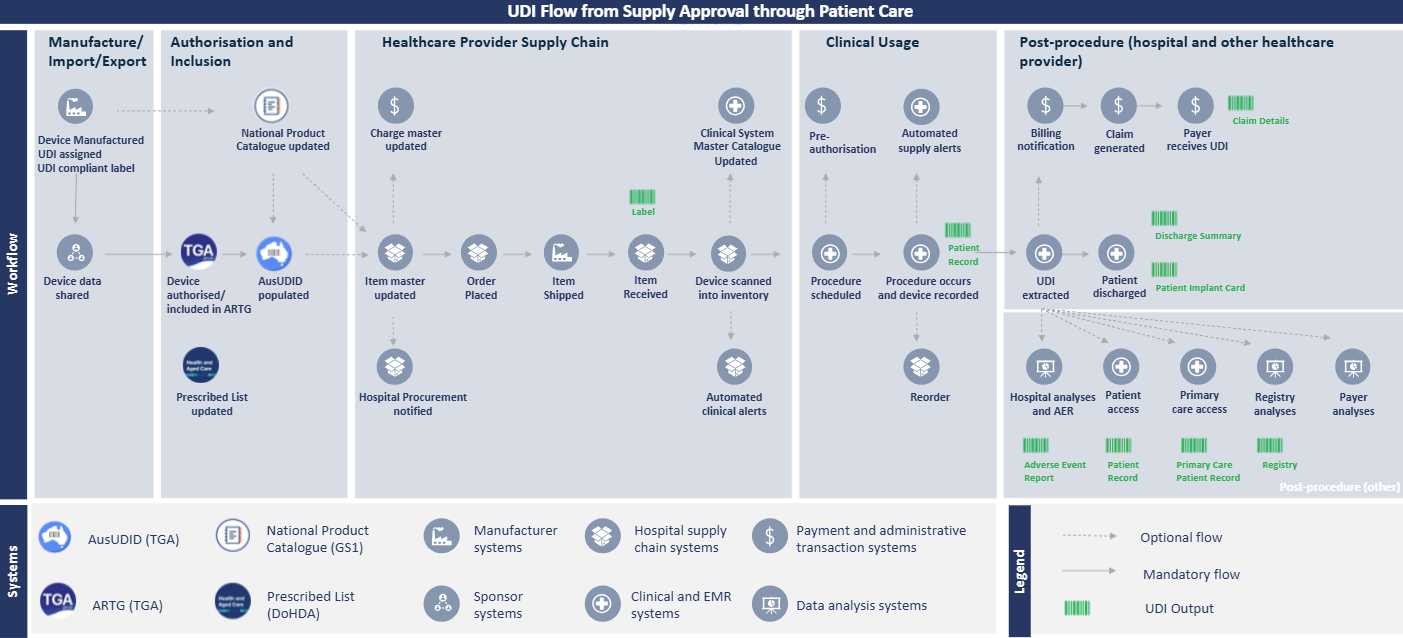

UDI provides identification for a device from the point of manufacture through regulatory approvals to supply, healthcare provider supply chain, clinical usage and finally post procedure which may include payers and registries.
Healthcare provider organisations vary considerably in their structure, resources, clinical services and technology environments. Each organisation will need to determine an approach to UDI adoption that aligns with its business needs, strategic priorities and digital roadmap.
Healthcare organisations that begin preparing early will be better positioned to realise the benefits of UDI, including improved patient safety, enhanced quality of care, more effective recall management, greater supply chain visibility and reduced operational costs.
Preparing for UDI adoption
The following high-level activities can help support UDI adoption.
1. Understand the value of UDI
Build awareness of how UDI can support patient safety, operational efficiency and healthcare delivery. Establishing a clear case for change can help secure organisational support and align UDI initiatives with broader strategic objectives.
2. Build organisational awareness
Provide staff with foundational knowledge about UDI and its potential uses across healthcare.
Awareness should extend beyond operational teams to include executive leaders, who play a key role in integrating UDI into strategic initiatives such as digital transformation, workforce planning, and service improvement programs.
Leverage international resources and implementation experiences from countries that have already adopted UDI and can help inform planning activities.
3. Assess systems and infrastructure
Assess existing systems to determine their readiness for UDI. This may include evaluating:
- storage and management of UDI data
- barcode scanning capabilities
- integration between systems
- data quality and interoperability requirements.
Systems most likely to be affected are those that handle product or patient data, such as:
- supply chain, inventory and warehouse management systems
- clinical systems, including theatre management systems
- electronic medical records and patient administration systems
- billing, claims and reimbursement systems
- biomedical asset management systems
- clinical quality registries
- incident management and recall management systems.
A change impact assessment can help identify system, workflow and data management requirements.
4. Develop a staged implementation approach
Many organisations may find a phased approach more achievable than implementing UDI across all systems and processes at once. Pilot projects and proof-of-concept activities can help organisations test approaches, identify challenges and demonstrate value before broader implementation.
Early activities may include improvements to labelling, data capture processes and inventory management practices. These changes can help build organisational understanding of UDI before investment in new technologies is required.
5. Strengthen scanning, integration and interoperability
Capturing UDI at the point of care often depends on reliable scanning technology and effective integration between systems.
Healthcare organisations should consider how UDI information can be shared across key systems and technologies, including:
- barcode scanners
- RFID readers
- inventory management systems
- procurement systems
- clinical systems
- electronic patient records.
Effective data sharing helps ensure device information remains accurate, current and available where it is needed.
6. Validate UDI data and processes
Physical validation of devices at key handling points can improve data quality and help confirm that devices are accurately tracked throughout the healthcare system. Validation activities can also help verify that device movement and location information is correctly recorded and shared between systems.
7. Plan for workforce and change management
Successful UDI adoption requires consideration of workforce impacts and change management from the outset. Healthcare organisations should engage staff early and address concerns that UDI implementation may increase workload, particularly at the point of care. Clear communication about the benefits of UDI and changes to workflows can help build understanding and support.
Changes to clinical, supply chain, inventory management and recall processes may require updates to existing workflows, responsibilities, data capture practices and information management processes. Organisations should review recall management procedures to ensure they can effectively use UDI data for identifying affected devices and patients.
During the transition period, organisations may need to operate dual processes to manage both UDI-compliant and non-UDI-compliant devices. This may affect clinical, supply chain and administrative activities until UDI adoption becomes more widespread.
Organisations should also identify education, training and change management requirements early to support a consistent understanding of UDI across the workforce and enable successful adoption of new processes and technologies.
The future of UDI
Countries around the world have implemented, or are in the process of implementing, UDI requirements for medical devices. As adoption increases globally, the availability, consistency and quality of UDI data will continue to improve. This will strengthen the ability of healthcare organisations, regulators and manufacturers to identify, trace and monitor medical devices throughout their lifecycle.
As UDI becomes more widely integrated into healthcare systems, supply chains, patient records and clinical quality registries, healthcare providers will be better positioned to use device data to support patient safety, informed decision-making and continuous improvement in healthcare delivery.
Patients are also expected to play an increasingly active role in the use of UDI information. Greater access to device information through resources such as the Australian UDI Database (AusUDID) will support transparency and help patients better understand the devices used in their care.
Australia's UDI system has been developed in collaboration with medical device manufacturers, sponsors, healthcare providers and other stakeholders. Continued collaboration across the healthcare sector will support the effective adoption of UDI and help realise its full benefits for patients, healthcare organisations and the broader health system.
Page history
Original publication
Original publication