

Understanding the general health or wellness software exclusion
Guidance on when consumer software products that promote general health or wellness may be excluded from our regulatory requirements.
Purpose
If you are a software developer, manufacturer or product sponsor it is your responsibility to check whether your software or digital product is excluded from our regulation before you release it for supply in Australia.
There are currently 15 excluded software categories listed in Schedule 1 of the Therapeutic Goods (Excluded Goods) Determination 2018 (the Determination).
This guidance relates to software intended for general consumer use to promote or facilitate general health or wellness, which may be excluded from our regulation under item 14B of the Determination.
Legislation
Introduction
We regulate all software-based products in Australia that meet the definition of a medical device unless they meet one of 15 excluded software categories.
If your product meets the definition of a medical device in Section 41BD of the Therapeutic Goods Act 1989 it must be included on the Australian Register of Therapeutic Goods (ARTG) before it can be marketed or supplied in Australia unless a valid exemption is in place.
However, software intended to be used by a consumer to promote or facilitate general health or wellness might be excluded from our regulation under item 14B of the Determination.
Note: Software with multiple functions
Every feature of software with multiple functionalities must meet the exclusion criteria to qualify for an excluded software category.
About this exclusion category
Exclusion 14B applies to consumer software or a combination of software and non-invasive hardware that is intended promote or facilitate general health or wellness by measuring or monitoring a physical parameter through non-invasive means.
Examples of physical parameters include:
- movement
- sleep
- heart rate
- heart rhythm
- temperature
- blood pressure
- oxygen saturation.
This category does not apply to software that makes any claims or treatment decisions about a serious disease, condition, ailment or defect.
An example of a serious condition is diabetes. Diabetes is considered serious as it requires the intervention of a health professional to be evaluated and treated effectively.
An example of a condition that is not serious is mild fever. A general consumer could reasonably evaluate whether they have a mild fever and manage it safely without the intervention of a health professional.
Extract: Item 14B
…software, or a combination of software and non-invasive hardware, that is:
- intended by its manufacturer to be used by a consumer to promote or facilitate general health or wellness by measuring or monitoring (through non-invasive means) a physical parameter, such as movement, sleep, heart rate, heart rhythm, temperature, blood pressure or oxygen saturation; and
- not intended by its manufacturer to be used:
- in clinical practice; or
- treatment, or making a recommendation or decision about the treatment, of a serious disease or a serious condition, ailment or defect.
Check if your software is excluded
This exclusion is based on 4 questions.
If you answer YES to the following 2 questions, this exclusion may apply:
- Is your product (software, or a combination of software and non-invasive hardware), intended for general consumer use?
- Is your product intended to promote and/or facilitate general health or wellness by measuring and/or monitoring a physical parameter through non-invasive means?
However, if you answer YES to any of the following, your software is not excluded:
- Is your product also intended for use in clinical practice?
- Does your product make claims about a serious disease, condition, ailment, or defect?
Flowchart for determining if software is excluded by 14B
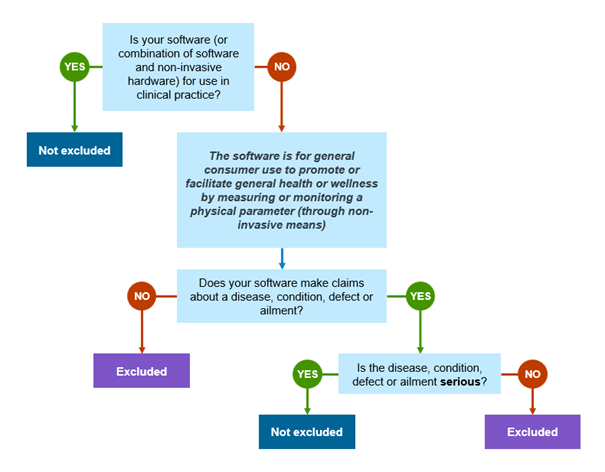

A flowchart for determining whether exclusion 14B applies to a general health or wellness software product.
The diagram includes 2 possible end states (1 and 2), each with 2 possible paths (a and b):
- Not excluded from our regulation (with 2 possible paths):
- software intended for clinical practice
- software makes disease‑related claims, and the disease/condition is serious.
- Excluded from our regulation (with 2 possible paths):
- software makes no disease‑related claims
- software makes disease claims, but the disease/condition is not serious.
Examples
Excluded software
Example: Fitness tracker app and wearable
A mobile phone app and wrist-worn sensor that tracks and compares the user’s resting heart rate and their heart rate during exercise to determine their workout intensity.
This software would be excluded from our regulation because it:
- does not provide information about a serious disease, condition, ailment, or defect
- is not used for diagnosis, or prognosis, or making decisions about treatment of any disease, condition, ailment, or defect.
It is not intended to detect medical irregularities or signs of fibrillation.
Not excluded
Example: Fitness tracker with heart rate warning
A mobile phone app and wrist-worn sensor that tracks and compares the user's resting heart rate and their heart rate during exercise to determine their workout intensity.
An additional function provides users with chronic heart conditions a warning when their heart rate is approaching a pre-set safety threshold.
This product would be regulated as a medical device because it is intended to:
- provide information to users in about a serious health condition
- indicate when they may be in danger.
Example: Post-surgery movement monitor
A wearable device and mobile app for users in post-surgery recovery to view their movements during exercise.
The app is recommended to patients by health professionals and may also recommend physical exercises to users to reduce their need for in-person appointments during recovery.
User data is sent from the app to the health professional to monitor and inform on recovery progress.
This software would be regulated as a medical device because it:
- is intended for clinical use
- can identify issues during a patient’s recovery that could be symptomatic of a serious disease, condition, defect, or ailment.
Glossary
| Term | Definition |
|---|---|
| Non-invasive hardware/non-invasive means | An invasive device is a medical device intended to be used to penetrate the body either through an orifice or body surface. For example, the skin. For the full definition, see the Therapeutic Goods (Medical Devices) Regulations 2002. Non-invasive hardware is described as any physical health or wellness device that is not intended to penetrate the body either through an orifice or the surface of the body. This includes non-invasive means of gathering medical information. This includes machines and/or systems such as X-rays, electrocardiograms (ECGs), and MRI or computed tomography (CT) scans. Non-invasive procedures can also sometimes be used as treatment. |
| Intended for | Your software has been designed, produced, and marketed for a particular purpose (or purposes). You must communicate and explain the purpose of your software to potential users, so they understand what it is for and what it is not for. All literature published about the software – even if it is just a comment on the screen – must be considered when determining whether a product is excluded or not. |
| General consumer use | This means:
|
| Clinical practice | This means: a healthcare facility such as a general practice (GP) clinic, pathology lab, health centre, hospital, or vaccination centre where a health professional is involved. For a full definition of 'health professional', see the Therapeutic Goods (Medical Devices) Regulations 2002. |
| Promote and/or facilitate general health or wellness | Recording and communicating broad (non-specific) health and wellness information only to a general consumer (e.g., a user's heart rate during exercise). It does not include information relating to a serious disease, condition, or ailment. |
| Physical parameter | A measure of a particular health or wellness characteristic. Examples include heart rate, heart rhythm, temperature, blood pressure or oxygen saturation, the amount and type of movement and the amount and type of sleep. This measure is not intended by its manufacturer to be used:
|
| Make claims about a disease, condition, ailment or defect | When the software is used for diagnosis, screening, prevention, monitoring, prediction, prognosis, alleviation, treatment or making decisions about treatment of a disease, condition, ailment, or defect, it will only be excluded if the disease or condition is not serious. |
| Disease condition, ailment or defect that is not serious | A disease or condition (including an ailment or defect) that:
A disease or condition must meet all these requirements to be defined as 'not serious'. If your software is intended to be used for a disease or condition that is serious then this exclusion does not apply, and your software will come under our regulations. |
Page history
Published using selected content previously located in guidance titled 'Understanding if your software-based medical device is excluded from our regulation.'
Published using selected content previously located in guidance titled 'Understanding if your software-based medical device is excluded from our regulation.'