

Understanding the electronic health records software exclusion
Software, or a combination of software and hardware, that is an electronic health record (EHR) may be excluded from our regulatory requirements.
Purpose
If you are a software developer, manufacturer or product sponsor it is your responsibility to check whether your software or digital product is excluded from our regulation before you release it for supply in Australia.
There are currently 15 excluded software categories listed in Schedule 1 of the Therapeutic Goods (Excluded Goods) Determination 2018 (the Determination).
This guidance relates to software or a combination of software and hardware that is an electronic health record, which may be excluded from our regulation under item 14M of the Determination.
Legislation
Introduction
We regulate all software-based products in Australia that meet the definition of a medical device unless they meet one of 15 excluded software categories.
If your product meets the definition of a medical device in Section 41BD of the Therapeutic Goods Act 1989 it must be included on the Australian Register of Therapeutic Goods (ARTG) before it can be marketed or supplied in Australia unless a valid exemption is in place.
However, some software or a combination of software and hardware that is an electronic health record (EHR) could be excluded from our regulation under item 14M of the Determination.
Note: Software with multiple functions
Every feature of software with multiple functionalities must meet the exclusion criteria to qualify for an excluded software category.
About this exclusion category
Exclusion 14M applies to software, or a combination of software and hardware, that is an electronic health record (however named or described).
Extract: Item 14M
Software, or a combination of software and hardware, that is an electronic health record (however named or described) and is:
intended by its manufacturer to be used in clinical practice by healthcare providers to collect, use, disclose and otherwise manage patient clinical data within or between healthcare facilities; and
not intended by its manufacturer to diagnose, screen for, prevent, monitor, predict, make a prognosis of, alleviate, treat, or make a recommendation or decision about the treatment of, a disease, condition, ailment, or defect.
Check if your software is excluded
This exclusion is based on 3 questions.
If you answer YES to the following 2 questions, the exclusion may apply:
- Does your product (software or a combination of software and hardware) function as an electronic health record regardless of how you have named or described?
- Is your product for use in clinical practice by health professionals to collect, use, disclose or otherwise manage patient clinical data within or between healthcare facilities?
If you answer YES to the following question, your software is not excluded:
- Does the software diagnose, screen for, prevent, monitor, predict, make a prognosis of, alleviate, treat or make recommendations or decisions about treatment of a disease, condition, defect or ailment?
Flowchart for determining if software is excluded by 14M
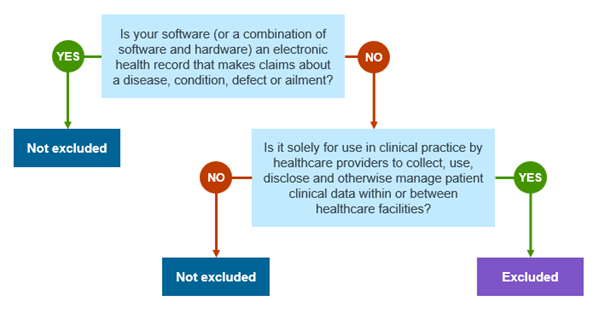

A diagram that visualises the excluded software category 14M decision pathway.
The diagram shows a decision tree used to determine whether software is excluded under category 14M.
The process starts with the question: "Is your software (or a combination of software and hardware) an electronic health record that makes claims about a disease, condition, defect, or ailment?"
If the answer is YES, the outcome is "Not excluded."
If the answer is NO, the process moves to a second question: "Is it solely for use in clinical practice by healthcare providers to collect, use, disclose, and otherwise manage patient clinical data within or between healthcare facilities?"
If the answer to this second question is YES the outcome is "Excluded."
If the answer to the second question is NO, the outcome is "Not excluded."
In summary, software is excluded under category 14M only when it does not qualify as an electronic health record that makes claims about a disease, condition, defect, or ailment, and when it is used solely in clinical practice by healthcare providers to manage patient clinical data within or between healthcare facilities. In all other scenarios, the software is not excluded.
Examples
Excluded software
Example: Software to manage and store patient data
Software that electronically stores and manages patient data in a general practice (GP) clinic but does no more than that. For example, doctors’ notes, past test results, and prescriptions.
The software allows health professionals to retrieve, view, and add new information about their patients.
This software would be excluded from our regulation because:
- it is an EHR intended for use by health professionals in a healthcare facility for information purposes only
- it does not diagnose, screen for, prevent, monitor, predict, make a prognosis of, alleviate, treat, or make recommendations or decisions about treatment of a disease, condition, defect, or ailment.
Not excluded
Example: Software to manage, store and analyse patient data
Software that electronically stores and manages data in a GP clinic and analyses that information to identify trends for the purposes of diagnosing a patient's disease, condition, defect, or ailment.
For example, a software module that analyses blood pressure information collected over a period to screen for chronic hypertension.
This software would not be excluded from our regulation because even though the software is an EHR, it is also used to screen patients for conditions.
Glossary
| Term | Definition |
|---|---|
| Electronic health record (EHR) | Software used to electronically collect, use, disclose and otherwise manage patient clinical data within or between healthcare facilities. This includes electronic medical records (EMR) and electronic patient records (EPR). These products are intended to do the same job as previously used paper records. These software products allow health professionals to see, review and update patient medical records and determine whether any clinical actions are required. For example, ordering more medications or scheduling tests or procedures. |
| Patient clinical data | Data that is specific to a patient and to that patient's health. For example, a patient's cholesterol levels or history of surgical procedures. It is different to data related to, for example, healthcare processes or facilities or general reference material. |
| Healthcare facilities | This means venues or locations that are professional places for administering one or more healthcare aspects or services. For example, hospitals, GP clinics, dental practices, and COVID-19 vaccination centres. |
| Make claims about a disease, condition, ailment or defect | If your software does any of the following:
…of a disease, condition, ailment, or defect, then it is not excluded. |
Page history
Published using selected content previously located in guidance titled 'Understanding if your software-based medical device is excluded from our regulation.'
Published using selected content previously located in guidance titled 'Understanding if your software-based medical device is excluded from our regulation.'