

Influenza vaccine batch release project for southern hemisphere 2026
Highlights and key Insights
The Influenza Batch Release and Testing Program for the southern hemisphere 2026 season determined the following:
- Total of 65 seasonal influenza vaccine batch release requests were processed by the TGA from seven products available (Fluad, Flucelvax, Influvac, FluMist, Fluzone, Fluzone High-Dose and Vaxigrip; See: 2026 Seasonal Influenza Vaccines.
- Protocols and company test results were reviewed and accepted for all 65 batches.
- TGA Laboratories tested 16 seasonal batches of inactivated influenza vaccines (32% of inactivated batches supplied) for Haemagglutinin (HA) content by single radial immunodiffusion (SRID) prior to release.
- All batches tested by SRID complied with potency specifications (see Table 1).
- Four inactivated vaccine batches were placed on a monitoring program to ensure HA stability throughout shelf-life.
- The Live Attenuated Influenza Virus (LAIV) vaccine FluMist was launched on the Australian market this season with 15 batches assessed. Testing undertaken by an independent international Official Medicines Control Laboratory (OMCL) passed specification.
- Three LAIV batches are included in ongoing stability testing by measuring potency titres using newly established fluorescence focus assay (FFA).
- Two batches of one product were released using the Official Control Authority Batch Release (OCABR) pathway.
- Nine batches experienced minor temperature excursions (range 0.9-14.6°C) from the approved shipping conditions of 2-8°C, which were assessed as acceptable based on temperature degradation stability study data.
Introduction and purpose
Seasonal influenza vaccines registered in Australia transitioned to the trivalent formulation this season and now contain 3 strains – two type A strains (H1N1 and H3N2) and one type B strains (B/Victoria lineage), as recommended the World Health Organization (WHO) and endorsed by the Australian Technical Advisory Group on Immunisation (ATAGI; ATAGI statement on the transition from quadrivalent to trivalent seasonal influenza vaccines in Australia). The seasonal composition of the vaccine changes on an annual basis to account for the rapid antigenic changes to the influenza virus. Multiple manufacturing platforms are utilised to produce these products.
For the southern hemisphere (SH) 2026 season, 7 vaccine products were available: 5 egg-derived (split virion and surface antigen), one cell-derived and one LAIV vaccine. Compared to the SH2025 influenza vaccine composition, two virus strain changes were made; the H1N1 strain changed from an A/Victoria/4897/2022 (H1N1)pdm09-like virus to an A/Missouri/11/2025 (H1N1)pdm09-like virus and the H3N2 strain changed from an A/Croatia/10136RV/2023 (H3N2)-like virus to a A/Singapore/GP20238/2024 (H3N2)-like virus. The B strain remained the B/Austria/1359417/2021 (B/Victoria lineage)-like virus and the B Yamagata lineage virus was removed.
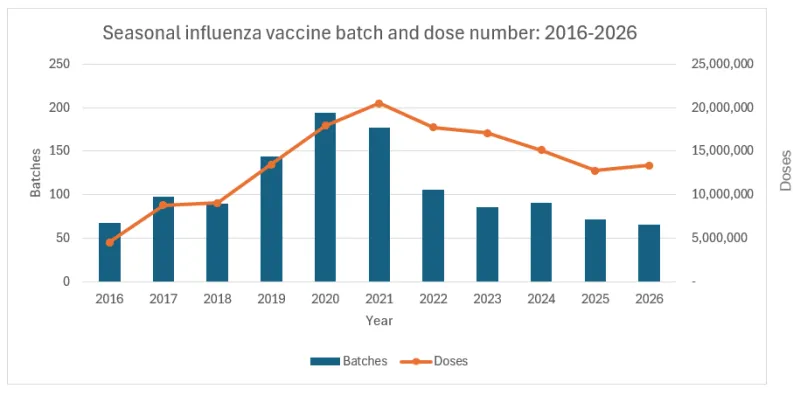
The number of batches processed and released by the TGA has varied from 2016 to 2026 (see Figure 1). This reflects the number of doses released per season, as well as the impacts of changes in pack size, number of packs batched together for shipping and which products were released with some products have a higher number of doses per batch. The number of batches released onto the Australian market provides sufficient doses to meet demand.
Testing
The Single Radial Immunodiffusion (SRID) assay was performed on selected batches of egg- and cell-derived inactivated vaccines to determine the influenza viral protein haemagglutinin (HA) content as per the European Pharmacopoeia guidelines (Ph. Eu. 04/2026:0158, 04/2026:0869 and 04/2026:2149). For the SH2026 influenza batch release testing program, 16 batches were selected.
To pass testing, the product must meet the confidence limit specifications of a lower confidence limit (P = 0.95) is not less than 80 per cent of the amount stated on the label for each strain to be acceptable. For products with a label claim of 15 µg HA/strain/dose (Fluad, Flucelvax, Influvac, Fluzone and Vaxigrip), that equates to a lower confidence limit (LCL) of 12 µg/strain/dose. For Fluzone High-Dose with a label claim of 60 µg HA/strain/dose, the LCL is 48 µg/strain/dose.
Test results are analysed using the European Directorate for Quality of Medicines and Healthcare (EDQM) CombiStats program.
Testing results are assessed in conjunction with review of manufacturer data for all batches to ensure both consistency of production and compliance with approved testing specifications. An exception to TGA review is when a batch is released using the European Union Official Control Authority Batch Release (OCABR) for Human Biologicals (Pathway 1). Overseas certification or test reports are used as evidence that the batch has already undergone independent testing and assessment by a recognised National Control Laboratory, similar and aligned to the assessment undertaken by the TGA.
Additional data, including shipping temperate conditions and product packaging (cartons and vial labels), are also assessed during the program.
Live attenuated influenza virus (LAIV) vaccines are not assessed using the SRID method. The Fluorescence Focus Assay (FFA) method has been established and stability testing of selected LAIV batches is ongoing as a confirmation of data submitted to the TGA pre-market. Batch release testing was performed on 5 batches by an independent international OMCL prior to release and passed potency specification of 6.5 – 7.5 Log10 Focus-Forming Units (FFU)/dose.
Results
All batches tested by SRID met HA content specifications (see Table 1).
| Sponsor | Product Name | ARTG | Batch No | Test Outcome Pass/Fail |
|---|---|---|---|---|
| Seqirus | Fluad | 306718 | 413687 | Pass |
| Seqirus | Fluad | 306718 | 413894 | Pass |
| Seqirus | Fluad | 306718 | 413700 | Pass |
| Seqirus | Fluad | 306718 | 413701 | Pass |
| Seqirus | Flucelvax | 452625 | 414558 | Pass |
| Seqirus | Flucelvax | 452625 | 414560 | Pass |
| Seqirus | Flucelvax | 452625 | 414559 | Pass |
| Seqirus | Flucelvax | 452625 | 414563 | Pass |
| Sanofi | Fluzone | 446170 | 6UA09U1 | Pass |
| Sanofi | Fluzone | 446170 | 6UA0GU1 | Pass |
| Sanofi | Fluzone | 446170 | 6UA0XU1 | Pass |
| Sanofi | Fluzone High Dose | 473685 | 6UA05U2 | Pass |
| Sanofi | Vaxigrip | 465534 | 6DA42D1 | Pass |
| Sanofi | Vaxigrip | 465534 | 6DA53D1 | Pass |
| Sanofi | Vaxigrip | 465534 | 6DA75D1 | Pass |
| Viatris | Influvac | 432811 | N09 | Pass |
Conclusion
Given the annual changes in influenza vaccine strains, it remains essential to ensure that consistent, high-quality seasonal influenza vaccines are available on the Australian market. The Influenza Batch Release and Testing Program confirms correct formulation, assesses production consistency, flags products requiring further evaluation due to low HA results and monitors batch stability.
The SH2026 Influenza Batch Release and Testing Program confirmed that all batches of inactivated influenza vaccine tested by SRID met the required potency specifications. Consistency in manufacturing and production processes was also confirmed across all egg-derived, cell-derived and LAIV products, and no quality concerns were identified for any influenza vaccine products supplied for the SH2026 season.
Based on test results and a thorough review of seasonal influenza vaccine manufacturing data, the influenza vaccines available in Australia are confirmed to be safe and produced to the high standards expected of biological products. They are suitable for all eligible Australians and are recommended to prevent serious infection, thereby protecting both individuals and the broader community.