

Understanding when health alert software systems qualify for exclusion
Guidance on when software that provides alerts to health professionals in relation to patient care may be excluded from our regulation.
Purpose
If you are a software developer, manufacturer or product sponsor it is your responsibility to check whether your software or digital product is excluded from our regulation before you release it for supply in Australia.
There are currently 15 excluded software categories listed in Schedule 1 of the Therapeutic Goods (Excluded Goods) Determination 2018 (the Determination).
This guidance relates to software that is for the sole purpose of providing alerts to health professionals in relation to patient care, which may be excluded from our regulation under item 14I of the Determination.
Legislation
Introduction
We regulate all software-based products in Australia that meet the definition of a medical device unless they meet one of 15 excluded software categories.
If your product meets the definition of a medical device in Section 41BD of the Therapeutic Goods Act 1989 it must be included on the Australian Register of Therapeutic Goods (ARTG) before it is marketed or supplied in Australia unless a valid exemption is in place.
However, software that provides alerts to health professionals may be excluded from our regulation under item 14I of the Determination.
Note: Software with multiple functions
Every feature of software with multiple functionalities must meet the exclusion criteria to qualify for an excluded software category.
About this exclusion category
Exclusion 14I applies to software that is for the sole purpose of providing alerts to health professionals in relation to patient care.
Extract: Item 14I
Software that is:
- intended by its manufacturer to be used for the sole purpose of providing alerts to health professionals in relation to patient care; and
- not intended by its manufacturer to:
- replace the clinical judgement of a health professional; or
- diagnose, screen for, prevent, alleviate, treat, or make a decision about the treatment of, a disease, condition, ailment or defect.
Note: Alarms versus alerts
Exclusion 14I does not apply to software that provides alarms to health professionals that must be actioned urgently.
For example, an alarm on a ventilator that requires an intensive care unit (ICU) nurse to take immediate action would not be excluded by 14I.
Check if your software is excluded
This exclusion is based on 3 questions.
If you answer YES to the following question, the exclusion may apply:
- Is your software for sole purpose of providing alerts to health professionals in relation to patient care?
If you answer YES to either of the following questions, your software is not excluded:
- Is your software intended to replace clinical judgment?
- Does the software diagnose, screen for, prevent, alleviate, treat, or make recommendations or decisions about treatment of a disease, condition, defect or ailment?
Flowchart for determining if software is excluded by 14I
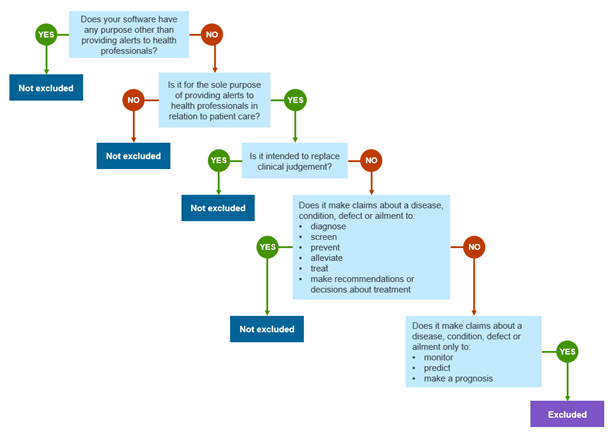

A decision flowchart for determining whether a medical software product is excluded from our regulation.
The diagram contains 5 decision points presented as sequential questions.
First question: "Does your software have any purpose other than providing alerts to health professionals?"
If YES, the outcome is "Not excluded."
If NO, go to the next question: "Is it for the sole purpose of providing alerts to health professionals in relation to patient care?"
If NO, the outcome is "Not excluded."
If YES, go to the next question: "Is it intended to replace clinical judgement?"
If YES, the outcome is "Not excluded."
If NO, go to the next question, which asks whether the software makes claims to diagnose, screen, prevent, alleviate, treat, or make treatment recommendations.
If YES, the outcome is "Not excluded."
If NO, go to the final question, which asks whether the software only monitors, predicts, or makes a prognosis for a disease or condition.
If YES, the outcome is "Excluded."
Examples
Excluded software
Example: Adverse drug interactions checker
Software that uses information from MIMS Australia to check potential prescriptions for any known adverse drug interactions before sending an information-only alert to a health professional.
After receiving the alert, the health professional decides whether to proceed with prescribing the medication queried.
The adverse drug interactions checker would be excluded from our regulation because:
- it is for the sole purpose of providing alerts to health professionals in relation to patient care
- it is not intended to replace clinical judgment and does not diagnose, screen for, prevent, alleviate, treat, or make recommendations or decisions about treatment of a disease, condition, defect, or ailment.
Example: Antibiotics prescription checker
Software that checks hospital prescriptions for antibiotics before sending an information-only alert to a health professional informing them of the hospital’s antimicrobial stewardship policy for the selected antibiotic.
After receiving the alert, the health professional decides whether to proceed with prescribing the antibiotics queried.
The antibiotics prescription checker would be excluded from our regulation because:
- it is for the sole purpose of providing alerts to health professionals in relation to patient care
- it is not intended to replace clinical judgment and does not diagnose, screen for, prevent, alleviate, treat, or make recommendations or decisions about treatment of a disease, condition, defect, or ailment.
Not excluded
Example: Adverse drug interactions prevention tool
Software that uses information from MIMS Australia to check potential prescriptions for any known adverse drug interactions before sending an alert to a health professional.
If the software finds details of any known adverse drug interactions for a medicine queried, the software will not allow the medicine queried to be prescribed.
Instead, it recommends alternative prescription medicines that return no details of known adverse drug interactions.
The adverse drug interactions prevention tool would not be excluded from our regulation because it intends to replace clinical judgment.
The software prevents health professionals from proceeding with their original prescription choice. The health professional must prescribe an alternative medicine based on the options presented by the software.
This software does not have a sole purpose of providing alerts to health professionals in relation to patient care.
The software is not excluded because:
- it intends to replace clinical judgment
- it makes recommendations or decisions about treatment of a disease, condition, defect, or ailment by recommending alternative medications.
Example: Heart rhythm data collection and screening tool
Software that collects and screens a patient’s heart rhythm data before sending an alert to a health professional to notify them if an arrythmia has been detected.
If the health professional needs to take immediate action, the software includes this in the alert.
The heart rhythm tool would not be excluded from our regulation because:
- the software does not solely provide alerts related to patient care, it also monitors and screens for arrythmias and provides alerts about required clinical actions
- a health professional could rely on this information to determine whether a clinical action is required.
Glossary
| Term | Definition |
|---|---|
| Sole purpose | Your software has one purpose only. It cannot be used for anything else. |
| Replace clinical judgment | The software is intended to take the place of a health professional when making a clinical decision. In other words, a treatment decision that has traditionally been performed by a human is performed instead by your software. Additionally, if the alert is providing unique clinical information that the health professional would not otherwise have access to, or cannot check in any way, the software is not excluded. This is because the clinician does not have access to all the information needed to judge whether the information is valid. |
| Make claims about a disease, condition, ailment or defect | Your software may be excluded, depending on what claims are made about the alerts. Your software is excluded if it provides an alert to a health professional relating to:
Your software is not excluded if it provides an alert to a health professional that is intended to inform:
…of a disease, condition, ailment, or defect. |
| Providing alerts to health professionals in relation to patient care | The software prepares and communicates some sort of notification (alert) to a health professional that relates to one or more aspects of a patient's care. This alert might remind a health professional that prescribed medication is ready to be dispensed, or alert that 2 medications that have been prescribed may have an adverse interaction. The health professional can make their own decision whether to take any action because of the alert or the information. For a full definition of 'health professional', see the Therapeutic Goods (Medical Devices) Regulations 2002. |
Page history
Published using selected content previously located in guidance titled 'Understanding if your software-based medical device is excluded from our regulation.'
Published using selected content previously located in guidance titled 'Understanding if your software-based medical device is excluded from our regulation.'