

Understanding the behavioural change or coaching software exclusion
Guidance on when consumer software products that encourage behavioural change to improve general health or wellness may be excluded from our regulations.
Purpose
If you are a software developer, manufacturer or product sponsor it is your responsibility to check whether your software or digital product is excluded from our regulation before you release it for supply in Australia.
There are currently 15 excluded software categories listed in Schedule 1 of the Therapeutic Goods (Excluded Goods) Determination 2018 (the Determination).
This guidance relates to software intended to improve general health or wellness by coaching or encouraging behavioural change, which may be excluded from our regulation under item 14C of the Determination.
Legislation
Introduction
We regulate all software-based products in Australia that meet the definition of a medical device unless they meet one of 15 excluded software categories.
If your product meets the definition of a medical device in Section 41BD of the Therapeutic Goods Act 1989 it must be included on the Australian Register of Therapeutic Goods (ARTG) before it is marketed or supplied in Australia unless a valid exemption is in place.
However, consumer software to improve users’ general health or wellness via coaching or encouraging behavioural change could be excluded from our regulation under item 14C of the Determination.
Note: Software with multiple functions
Every feature of software with multiple functionalities must meet the exclusion criteria to qualify for an excluded software category.
About this exclusion category
Exclusion 14C applies to software intended to be used by a consumer to improve general health or wellness via coaching, or encouraging behavioural change, in relation to personal or environmental factors, such as weight, exercise, sun exposure or dietary intake.
Extract: Item 14C
Software that is:
- intended by its manufacturer to be used by a consumer to improve general health or wellness by coaching, or encouraging behavioural change, in relation to personal or environmental factors, such as weight, exercise, sun exposure or dietary intake; and
- not intended by its manufacturer to be used:
- in clinical practice or to provide information to the consumer that would generally be accepted to require the interpretation of a health professional; or
- for the purpose of diagnosis, prognosis, or making a decision about the treatment, of a disease, condition, ailment or defect.
Check if your software is excluded
This exclusion is based on 5 questions.
If you answer YES to the following 2 questions, this exclusion may apply:
- Is your software intended for improving general health or wellness through coaching or behavioural change (e.g., limiting sun exposure, modifying diet or exercise habits)?
- Is your software for general consumer use?
However, if you answer YES to any of the following, your software is not excluded:
- Is your software also for use in clinical practice?
- Does your software provide information to the consumer that would generally be accepted to require the interpretation of a health professional?
- Is the software used for diagnosis, or prognosis, or making decisions about treatment of any disease, condition, defect, or ailment?
Flowchart for determining if software is excluded by 14C
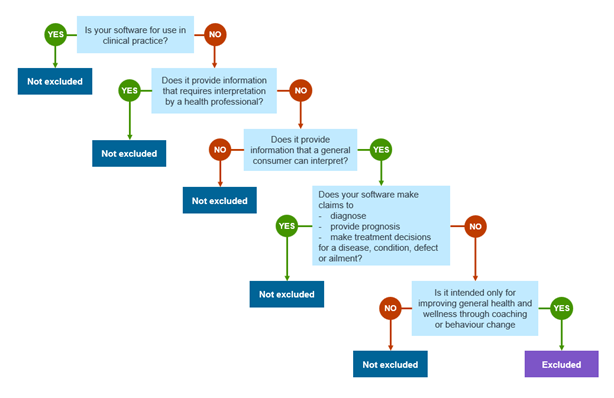

A decision flowchart used to determine whether software is excluded or not excluded from a particular regulatory category.
The flow proceeds from top to bottom, with each decision answered Yes or No, leading to an outcome.
First decision: "Is your software for use in clinical practice?"
- YES: The software is not excluded. The process ends.
- NO: Proceed to the next decision.
Second decision: "Does it provide information that requires interpretation by a health professional?"
- YES: The software is not excluded. The process ends.
- NO: Proceed to the next decision.
Third decision: "Does it provide information that a general consumer can interpret?"
- NO: The software is not excluded. The process ends.
- YES: Proceed to the next decision.
Fourth decision: "Does your software make claims to diagnose, provide prognosis, or make treatment decisions for a disease, condition, defect, or ailment?"
- YES: The software is not excluded. The process ends.
- NO: Proceed to the next decision.
Fifth decision: "Is it intended only for improving general health and wellness through coaching or behaviour change?"
- NO: The software is not excluded. The process ends.
- YES: The software is excluded.
Examples
Excluded software
Example: Sun-smart app
A sun-smart app that gives the user alerts about protection from ultraviolet (UV) radiation to minimise skin cancer risk.
The software would be excluded from our regulation because although it focuses on a health-related issue, it only provides information and is not used for diagnosis, or prognosis, or making decisions about treatment of any disease, condition, defect, or ailment.
Not excluded
Example 2: Weight monitor
Software that monitors a user's weight and provides advice to take or cease taking prescription weight control medication depending on trends in the data.
This software would not be excluded from our regulation because in addition to providing information and coaching and/or behavioural changes, it is also used for making recommendations or decisions about treatment of a disease, condition, defect, or ailment.
Where products make claims about chronic disease associated with lifestyle, they are not excluded.
Glossary
| Term | Definition |
|---|---|
| Coaching or behavioural change | Teaching or advising a person on making changes to their health habits. For example:
|
| General health and wellness | Broad or non-specific health or wellness issues, for example a person's state of mind, general mobility, or fitness. |
| General consumer use | This means: you intend your software to be used by a consumer only
|
| Clinical practice | This means:
For a full definition of health professional, see the Therapeutic Goods (Medical Devices) Regulations 2002. |
| Interpretation of a heath professional | You need to ask yourself if your software can be understood and used by a general consumer with no medical training or knowledge or can it only be understood and used by a patient if it is explained to them by a health professional. For example, a general consumer could read a temperature reading from a thermometer but may not be able to interpret the implications of having certain levels of inflammatory markers in their blood. |
| Diagnosis or prognosis | Software that identifies, detects, informs, or advises a person of the probability and/or the presence of a disease, condition, ailment or defect or the likely course of the disease, condition, ailment, or defect. |
| Making decisions about treatment | Software that identifies, makes decisions, and/or helps a patient and/or a health professional decide what treatment to undertake to address or 'treat' a health condition. This includes providing recommendations or suggestions to undertake a treatment. |
Page history
Published using selected content previously located in guidance titled 'Understanding if your software-based medical device is excluded from our regulation.'
Published using selected content previously located in guidance titled 'Understanding if your software-based medical device is excluded from our regulation.'