

Understanding the digital mental health tool software conditional exclusion
Guidance on when consumer software products like apps or websites intended to support users' mental health are excluded from our regulatory requirements.
Purpose
If you are a software developer, manufacturer or product sponsor it is your responsibility to check whether your software or digital product is excluded from our regulation before you release it for supply in Australia.
There are currently 15 excluded software categories listed in Schedule 1 of the Therapeutic Goods (Excluded Goods) Determination 2018 (the Determination).
This guidance relates to software that is a digital mental health tool (DMHT), which may be excluded from our regulation under item 14E of the Determination.
Legislation
Introduction
We regulate all software-based products in Australia that meet the definition of a medical device unless they meet one of 15 excluded software categories.
If your product meets the definition of a medical device in Section 41BD of the Therapeutic Goods Act 1989 it must be included on the Australian Register of Therapeutic Goods (ARTG) before it is marketed or supplied in Australia unless a valid exemption is in place.
However, software intended to be used as a DMHT may be excluded from our regulation under item 14E of the Determination.
About this exclusion category
Some DMHTs are excluded from our regulation. This means they do not need to be included in the Australian Register of Therapeutic Goods (ARTG).
Exclusion 14E is a conditional exclusion that applies to software that is a DMHT including cognitive behaviour therapy tools based on established clinical practice guidelines that are referenced, displayed, and reviewable by users within the software.
Extract: Item 14E
Software that is a digital mental health tool (including a cognitive behaviour therapy tool) based on established clinical practice guidelines that are referenced and displayed in the software in a manner that is reviewable by the user.
Check if your software is excluded
Note: Clinical trials
If your software is part of a novel treatment still undergoing clinical trials it is not excluded. You may need to apply for an exemption.
This exclusion is based on 4 questions.
If you answer YES to the following 4 questions, the exclusion may apply:
- Is your software intended to be used for mental health?
- Does your software follow an established clinical practice guideline?
- Is the guideline referenced in your software?
- Is the reference displayed in the software so the user can clearly view it?
Flowchart for determining if software is excluded by 14E
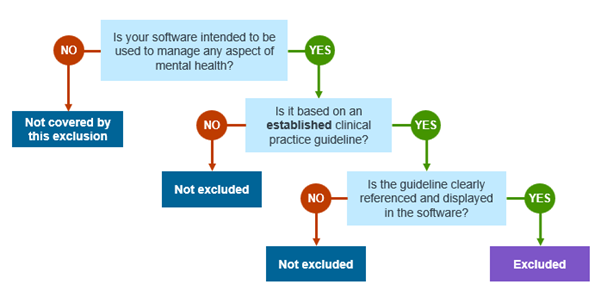

A flowchart to explain the decision process for determining whether software is excluded from our regulation based on its use in mental health and its reliance on clinical guidelines.
The decision flow begins with a question at the top: "Is your software intended to be used to manage any aspect of mental health?"
If the answer is NO, the process ends with the outcome: "Not covered by this exclusion."
If the answer is YES, the flow continues to the next question.
The second question asks: "Is it based on an established clinical practice guideline?"
If the answer is NO, the outcome is "Not excluded."
If the answer is YES, the flow continues to a third question.
The third question asks: "Is the guideline clearly referenced and displayed in the software?"
If the answer is NO, the outcome is "Not excluded."
If the answer is YES, the outcome is "Excluded."
Examples
Excluded software
Example: Website for digital therapy sessions for anxiety
A website that offers digital therapy sessions to help treat anxiety, for example cognitive behavioural therapy (CBT).
Sessions on a web page on the website follow established clinical practice guidelines published by the Royal Australian and New Zealand College of Psychiatrists, (RANZCP) and the web page links directly to specific RANZCP guidelines.
This tool would be excluded from our regulation because it follows an established clinical practice guideline and the web page links directly to the RANZCP guideline followed.
Example: Cognitive behavioural therapy app for anxiety
A mobile app that provides cognitive behavioural therapy (CBT) to help users manage severe anxiety.
The app follows RANZCP’s clinical practice guidelines, references those guidelines on launch screens when users open the app and provides a link to the guidelines on the RANZCP website.
This app would be excluded from our regulation because it references and links to widely accepted clinical practice guidelines.
Example: Inpatient symptom checker app
A mobile app that monitors self-reported mental health indicators for inpatients at a specific health facility as they undergo care including surgery, chronic disease management, or emergency treatment.
The app includes a symptom checker based on the facility's clinical practice guidelines, with the results sent to the supervising clinician.
With patient consent and after deidentification, the data is also shared with a partner university for research purposes. The clinical team may act on the results provided by the app.
While the app includes a diagnostic and monitoring function which makes it a medical device, it uses and displays the healthcare facility’s published clinical practice guidelines so meets the criteria for exclusion as a DMHT.
Example: Depression assessment website
A website that provides a range of quizzes and interactive games to help users decide if they may be at risk of depression.
A high-medium-low risk assessment is provided at the end of each quiz. The website does not collect personal identifying information.
The clinical practice guidelines for treating depression are displayed prominently on the website. A range of resources are provided to users depending on their responses, including contact information on where to get immediate support and links to websites with more mental health information.
This website would not be regulated by us because it is not a medical device. This is because it does not diagnose depression, it only provides a simple high-medium-low indication.
The website also meets the conditions of exclusion because it prominently displays the clinical practice guidelines for treating depression.
Not excluded
Example: Website for treating depression
A website that uses an innovative treatment for depression.
There are some preliminary papers published about this treatment, but no clinical practice guidelines have been established and the treatment is not in wide use.
This website would not be excluded from our regulation because it does not follow an established clinical practice guideline.
Glossary
| Term | Definition |
|---|---|
| Intended to be | Software designed and produced for a particular purpose or purposes. You must communicate and explain the purpose or purposes of your software to potential users so they understand what it is for and what it is not for. |
| Used in mental health | Anything related to a mental health (and only mental health) disease, condition, ailment, or defect, (e.g., a diagnosis) and any treatment related to mental health. Software that uses psychological tools to manage a physiological condition is not covered under this exclusion. For example, a smartphone app that uses cognitive behavioural therapy to manage symptoms of diabetes. |
| Follow an established clinical practice guideline | The software implements a DMHT that’s widely accepted in clinical practice in Australia. This usually means that clinical practices and organisations that represent health professionals have published guidelines. However, the guideline can also have been published by a hospital or an individual who is an expert. It is unlikely that a single guideline like a published research paper would be considered 'established' in clinical practice. The guideline must be recognised and widely accepted by clinical practices and organisations that represent healthcare providers and established for use in Australia. Likewise, creating your own guideline for use in your product would not be sufficient to meet the criteria as the guideline must be widely accepted and established for use in Australia. The guideline must be recognised by a relevant health professional body or a national body such as the Australian Commission on Safety and Quality in Healthcare. |
| Referenced and displayed in the software | Users need to be able to clearly identify the specific clinical practice guideline or guidelines the software follows. The guidelines must be referenced and displayed so the user can easily see and access them. Incorporating links to guidelines is acceptable, but only if they are directly available to users. For example, displayed within an app. Displaying links in a user manual is not enough for the software to be excluded. |
| Novel treatment still undergoing trials | If the treatment your software facilitates is undergoing clinical trials, it means it is not yet established in clinical practice. This means the software is not excluded and still regulated by us. You may need to consider if you need to apply to us for an exemption to use your software in a clinical trial. |
Page history
Published using selected content previously located in guidance titled 'Understanding if your software-based medical device is excluded from our regulation.'
Published using selected content previously located in guidance titled 'Understanding if your software-based medical device is excluded from our regulation.'