

Understanding the patient survey software exclusion
Guidance on when software used as a patient reported outcome measures (PROMs) questionnaire or patient survey may be excluded from our regulation.
Purpose
If you are a software developer, manufacturer or product sponsor it is your responsibility to check whether your software or digital product is excluded from our regulation before you release it for supply in Australia.
There are currently 15 excluded software categories listed in Schedule 1 of the Therapeutic Goods (Excluded Goods) Determination 2018 (the Determination).
This guidance relates to software intended to be used as a patient reported outcome measures (PROMs) questionnaire or patient survey, which may be excluded from our regulation under item 14D of the Determination.
Legislation
Introduction
We regulate all software-based products in Australia that meet the definition of a medical device unless they meet one of 15 excluded software categories.
If your product meets the definition of a medical device in Section 41BD of the Therapeutic Goods Act 1989 it must be included on the Australian Register of Therapeutic Goods (ARTG) before it is marketed or supplied in Australia unless a valid exemption is in place.
However, software used as a patient reported outcome measures (PROMs) questionnaire or patient survey could be excluded from our regulation under item 14D of the Determination.
Note: Software with multiple functions
Every feature of software with multiple functionalities must meet the exclusion criteria to qualify for an excluded software category.
About this exclusion category
Exclusion 14D applies to software intended to be used as a patient reported outcome measures (PROMs) questionnaire or patient survey.
Extract: Item 14D
Software that is:
intended by its manufacturer to be used as a patient reported outcome measures (PROMs) questionnaire or patient survey; and
not intended by its manufacturer to diagnose, screen for, monitor, predict, make a prognosis of, alleviate, treat, or make a recommendation or decision about the treatment of, a disease, condition, ailment, or defect.
Check if your software is excluded
This exclusion is based on 2 questions.
If you answer YES to the first question this exclusion may apply:
- Is your software a PROMs questionnaire or patient survey?
However, if you answer YES to the second question, your software is not excluded:
- Does your software make claims about a disease, condition, ailment, or defect?
Flowchart for determining if software is excluded by 14D
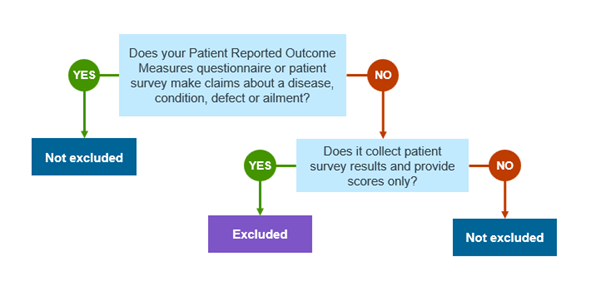

A decision flowchart used to determine whether software related to patient reported outcome measures (PROMs) is excluded or not excluded from a specific category.
The flow proceeds from left to right, with decisions answered YES or NO, each leading to an outcome.
First decision: "Does your Patient Reported Outcome Measures questionnaire or patient survey make claims about a disease, condition, defect or ailment?"
- YES: The software is not excluded. The process ends.
- NO: Proceed to the next decision.
Second decision: "Does it collect patient survey results and provide scores only?"
- YES: The software is excluded. The process ends.
- NO: The software is not excluded. The process ends.
Examples
Excluded software
Example: Digital questionnaire for people with cancer
A digitised PROMs questionnaire for assessing quality of life for patients receiving treatment for cancer. The questionnaire provides the same information as a paper questionnaire.
The information collected is stored in the patient’s medical records.
The application is used to inform patients' care but is not used to diagnose, screen, prevent, monitor, predict, provide a prognosis, alleviate, or treat their cancer.
This software would be excluded from our regulation because it is not used to diagnose, treat, screen for, monitor, predict, alleviate, or provide a prognosis for cancer.
Example: Patient survey to screen for health disorders
An application that digitises an established patient survey used to help clinicians screen for certain health disorders.
The survey presents patients with multiple choice questions about their situation and calculates a risk score based on predetermined weightings.
Patients’ responses and risk score are provided to a clinician who may use this to inform their patient’s care.
The software displays the logic of the risk score calculation to the clinician and references the established survey it implements.
This app would be excluded from our regulation because although clinicians use the survey to help screen for a condition, the software itself is not performing the screening.
This is because the software itself is not
- making inferences about the patient’s condition
- making a recommendation or decision related to patient care for diagnosis, treatment, etcetera.
Example: Digitised Patient Health Questionnaire-9 (PHQ-9) for health professionals
An app that digitises the PHQ-9 survey, a standardised screening tool commonly used to assess the severity of depression.
The app collects users' inputs and provides the results to a health professional.
This app would be excluded from our regulation because the software is limited to collecting information which the health professional may or may not choose to use when deciding to screen for the presence and severity of depression.
The software itself does not perform a screening function.
Not excluded
Example: Cancer prediction app
An app that asks users to fill out a questionnaire or survey to predict their likelihood of having a certain cancer.
This cancer prediction app would not be excluded from our regulation because the software is a patient survey used to screen for a disease, condition, ailment, or defect.
The software itself is determining the likelihood of the patient having cancer, rather than providing information to a user to interpret.
Example: App to identify serious inflammatory disorders
A desktop application to help general practitioners (GPs) identify the presence of serious inflammatory disorders in patients.
It uses an algorithm to combine patient survey results with photographs of 'affected areas.'
The application is intended to provide a substitute a specialist examination by a rheumatologist. The next action is referral to a specialist or further testing.
This software would not be excluded from our regulation because it is doing more than simply collecting data. It is also analysing the information collected to diagnose a condition.
Example: Digitised PHQ-9 survey for consumers
A mobile app for general consumer use that digitises the PHQ-9 survey commonly used by health professionals to check for the presence and severity of depression in patients.
The app analyses the user's inputs and states the presence and severity of depression directly to the user.
This app would not be excluded from our regulation because the software is doing more than collecting information, it is also analysing data to screen for a condition.
Glossary
| Term | Definition |
|---|---|
| Patient reported outcome measures (PROMs) questionnaire | A PROMs questionnaire asks patients for information about their health outcomes from their perspective, rather than that of a health professional. The information gathered helps to measure changes in a patient's general health status. For example, in their acute and/or chronic pain, or their depression. Questions they ask:
PROMs are designed for patients, but sometimes a carer or nominated support person can also fill them out. A PROMs questionnaire might also be one that forms part of an electronic health record (EHR). A PROMs questionnaire is an example of a patient survey. For more information, see Australian Commission on Safety and Quality in Healthcare's guidance on PROMs for consumers. |
| Patient survey | People are sometimes asked to fill out surveys to help with screening. Increasingly, paper-based surveys are going digital. For example, via a mobile phone or tablet app. Software that is a patient survey is not a medical device when its purpose is limited to exclusively collecting patient data via the user inputting responses to survey questions. The software is excluded depending on what’s done with the data collected. Software may be excluded in cases where software automates the calculation of scores for collected survey results according to established rules. For example, when survey results are then presented to a health professional who makes a diagnostic or screening decision. Software is not excluded where the software itself is further analysing the survey responses and/or combining the responses/score with other data. In these cases, the software may be providing unique diagnostic or screening information and/or making inferences about a patient's condition to make a recommendation or decision related to patient care. Where the software makes a prediction about risk of a disease or condition, it would not be excluded. |
| Make claims about a disease, condition, ailment or defect | When software is used for diagnosis, screening, prevention, monitoring, prediction, prognosis, alleviation, treatment or making decisions about treatment of a disease, condition, ailment, or defect, it is not excluded. |
Page history
Published using selected content previously located in guidance titled 'Understanding if your software-based medical device is excluded from our regulation.'
Published using selected content previously located in guidance titled 'Understanding if your software-based medical device is excluded from our regulation.'