
Understanding the health self-management software exclusion
Guidance on when software products for consumers to self-manage an existing disease or health condition may be excluded from our regulatory requirements.
Purpose
If you are a software developer, manufacturer or product sponsor it is your responsibility to check whether your software or digital product is excluded from our regulation before you release it for supply in Australia.
There are currently 15 excluded software categories listed in Schedule 1 of the Therapeutic Goods (Excluded Goods) Determination 2018 (the Determination).
This guidance relates to software to software intended for self-management of an existing disease or condition that is not serious, which may be excluded from our regulation under item 14A of the Determination.
Legislation
Introduction
We regulate all software-based products in Australia that meet the definition of a medical device unless they meet one of 15 excluded software categories.
If your product meets the definition of a medical device in Section 41BD of the Therapeutic Goods Act 1989 it must be included on the Australian Register of Therapeutic Goods (ARTG) before it can be marketed or supplied in Australia unless a valid exemption is in place.
However, some software products intended for consumers to self-manage a health condition could be excluded from our regulation under item 14A of the Determination.
Note: Software with multiple functions
Every feature of software with multiple functionalities must meet the exclusion criteria to qualify for an excluded software category.
About this exclusion category
Exclusion 14A applies to software intended for self-management of an existing disease or condition that is not serious, without providing specific treatment or treatment suggestions.
This category does not apply to software that makes any claims or treatment decisions about a serious disease, condition, ailment or defect.
An example of a serious condition is diabetes. Diabetes is considered serious as it requires the intervention of a health professional to be evaluated and treated effectively.
An example of a condition that is not serious is mild fever. A general consumer could reasonably evaluate whether they have a mild fever and manage it safely without the intervention of a health professional.
Extract: Item 14A
Software that is:
- intended by its manufacturer to be used by a consumer for the self-management of an existing disease, condition, ailment, or defect that is not a serious disease or serious condition, ailment, or defect; and
- not intended by its manufacturer to be used:
- in clinical practice; or
- in relation to a serious disease or serious condition, ailment, or defect; or
- for the purpose of diagnosis, treatment, or making a specific recommendation or decision about the treatment, of a disease, condition, ailment, or defect that is not a serious disease or serious condition, ailment, or defect.
Check if your software is excluded
This exclusion is based on 5 questions.
If you answer YES to the following two questions, the exclusion may apply:
- Is your software intended for general consumer use?
- Is your software for the self-management of an existing disease or condition?
If you answer YES to any of the following questions, your software is not excluded:
- Is the disease, condition, ailment or defect serious?
- Is your software also intended for use in clinical practice?
- Does the software diagnose, directly treat, or make specific treatment recommendations or decisions?
Flowchart for determining if software is excluded by 14A
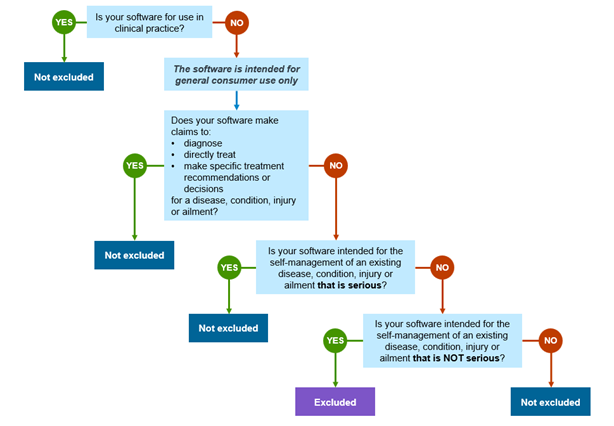

A multi‑step decision flowchart that explains when consumer health software is excluded or not excluded from our regulation.
The flowchart progresses through a series of yes‑or‑no questions, with each path leading to a final determination.
The flow starts with the question: "Is your software for use in clinical practice?"
If the answer is YES, the software is not excluded, and the decision process ends.
If the answer is NO, the flow continues and states that the software is intended for general consumer use only, then proceeds to the next question.
The next question asks:
"Does your software make claims to:
- diagnose
- directly treat
- make specific treatment recommendations
…for a disease, condition, injury or ailment?"
If the answer is YES, the software is not excluded, and the decision process ends.
If the answer is NO, the flow continues to the next question.
The next decision point asks: "Is your software intended for the self‑management of an existing disease, condition, injury or ailment that is serious?"
If the answer is YES, the software is not excluded, and the decision process ends.
If the answer is NO, the flow continues to the final question.
The final question asks: "Is your software intended for the self‑management of an existing disease, condition, injury or ailment that is not serious?"
If the answer is YES, the software is excluded.
If the answer is NO, the software is not excluded.
Examples
Excluded software
Example: Self-management of tinnitus
An app that enables a user to self-manage tinnitus by describing techniques to the user for the purposes of improving well-being and reducing the level of tinnitus-related annoyance.
The software would be excluded from our regulation because it is intended for self-management of a non-serious disease, condition, ailment, or defect (tinnitus) and does not make recommendations or decisions about treatment.
Not excluded
Example: Diagnosis of tinnitus
An app intended to be used by a health professional to diagnose tinnitus and determine appropriate sound therapy for treatment.
The software would not be excluded from our regulation because even though tinnitus is considered a non-serious condition, this software is intended for the:
- diagnosis of a condition that is not serious
- treatment of tinnitus by a health professional (so, not self-management).
Example: Managing pre-existing diabetes
An app intended to be used by a general consumer to manage their pre-existing diabetes.
The app allows users to view their blood glucose levels, track trends over time and provides alerts if the levels are outside pre-set ranges.
This software would not be excluded from our regulation because it is intended for the management of a serious condition (diabetes).
The app relies on tracking of blood glucose levels and not on encouraging choices towards a healthy lifestyle such as weight management, healthy eating, or physical activity.
Glossary
| Term | Definition |
|---|---|
| Intended for | Your software has been designed, produced, and marketed for a particular purpose or purposes. You must communicate and explain the purpose of your software to potential users, so they understand what it is for and what it is not for. |
| Self-management | The software will be used by a general consumer (or their carer) to manage an existing disease or condition and is not intended for use by a health professional and/or in clinical practice. If this is the case, then the software is 'intended for self-management' and could be excluded. 'Self-management', as distinguished from 'treatment', refers to enabling users to make healthy lifestyle choices (e.g., weight management and physical activity) that are medically accepted to help reduce the risk (e.g., of complications) or impact of an existing disease or condition. If the general consumer shares information generated by your software with a healthcare provider but it is not used for diagnosis or treatment, the software is still 'intended for self-management' and it is excluded. But, if the healthcare provider and/or the clinical practice does use the software-generated information for any diagnosis or treatment, the software is no longer 'intended for self-management'. In this case, the software is not excluded. |
| Clinical practice | In this case means:
For a full definition of ‘health professional’, see the Therapeutic Goods (Medical Devices) Regulations 2002. |
| Existing | A disease or condition that may or may not have been previously diagnosed by a medical practitioner. |
| Without providing specific treatment or treatment suggestions | Your software is restricted to monitoring and reporting on the current state of a disease or condition and helping with self-management only. Your software only provides information that can help the user track the state of the disease or condition or self-manage it. It does not provide anything more than this information. This also means your software is not intended to be used for either:
If your software is intended to be used for either of these tasks, then this exclusion does not apply, and your software will be regulated by us. |
| Disease condition, ailment or defect that is not serious | A disease or condition including an ailment or defect that:
A disease or condition must meet all these requirements to be defined as 'not serious.' If your software is intended to be used for a disease or condition that is serious then this exclusion does not apply, and your software will be regulated by us. |
Page history
Published using selected content previously located in guidance titled 'Understanding if your software-based medical device is excluded from our regulation.'
Published using selected content previously located in guidance titled 'Understanding if your software-based medical device is excluded from our regulation.'