

Understanding the laboratory information management software exclusion
Guidance about when certain types of laboratory information management systems (LIMS) and laboratory information systems (LIS) may be excluded from our regulatory requirements.
Purpose
If you are a software developer, manufacturer or product sponsor it is your responsibility to check whether your software or digital product is excluded from our regulation before you release it for supply in Australia.
There are currently 15 excluded software categories listed in Schedule 1 of the Therapeutic Goods (Excluded Goods) Determination 2018 (the Determination).
This guidance relates to certain types of laboratory information management systems (LIMS) and laboratory information systems (LIS) software, which may be excluded from our regulation under item 14O of the Determination.
Legislation
Introduction
We regulate all software-based products in Australia that meet the definition of a medical device unless they meet one of 15 excluded software categories.
If your product meets the definition of a medical device in Section 41BD of the Therapeutic Goods Act 1989 it must be included on the Australian Register of Therapeutic Goods (ARTG) before it is marketed or supplied in Australia unless a valid exemption is in place.
However, software that is a laboratory information management system may be excluded from our regulation under item 14O of the Determination.
About this exclusion category
Exclusion 14O applies to software that is a laboratory information management system, however named or described.
Extract: Item 14O
Software that is a laboratory information management system (however named or described) and is not intended by its manufacturer to:
- manipulate information or data to change, or generate new, diagnostic outputs (other than automating simple calculations or generating report comments); or
- prevent, monitor, predict, make a prognosis of, treat or alleviate a disease, condition, ailment or defect.
Check if your software is excluded
This exclusion is based on 3 questions.
If you answer YES to the following question, the exclusion may apply:
- Is your software a laboratory information management system (however named or described)?
If you answer YES to any of the following questions, your software is not excluded:
- Does your software manipulate information or data to change, or generate new, diagnostic outputs (other than automating simple calculations or generating report comments)?
- Does the software prevent, monitor, predict, make a prognosis of, alleviate, or treat a disease, condition, ailment, or defect?
Flowchart for determining if software is excluded by 14O
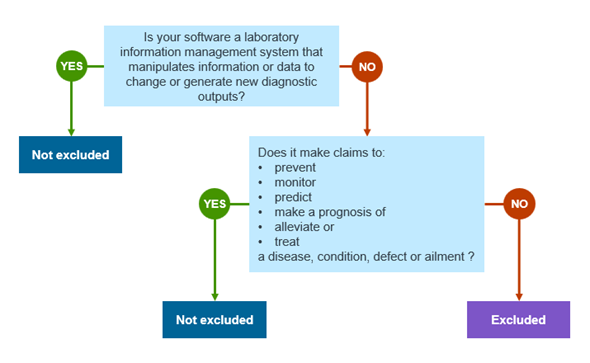

A decision flowchart that explains when software is excluded or not excluded from our regulation.
The flowchart progresses through a series of yes‑or‑no questions, with each path leading to a final outcome.
The process begins with the question: “Is your software a laboratory information management system that manipulates information or data to change or generate new diagnostic outputs?”
If the answer is YES, the software is not excluded, and the decision process ends.
If the answer is NO, the flow continues to the next question.
The next decision point asks whether the software makes clinical claims. The question is presented with a list of possible claim types:
"Does it make claims to:
- prevent
- monitor
- predict
- make a prognosis of
- alleviate or
- treat
…a disease, condition, defect or ailment?"
If the answer is YES, the software is not excluded, and the decision process ends.
If the answer is NO, the software is excluded.
Examples
Excluded software
Example: Software that manages workflows and data
Software that automates workflows, integrates instruments, manages samples, and reports results of assays.
The software allows for pathologists to annotate test results and create notes but does not itself recommend a diagnosis or treatment.
This software would be excluded from our regulation because it only manages workflows and data. The software records, saves, sends, and makes data available.
The software is not used for the prevention, monitoring, prediction, making a prognosis of, alleviating, or treating a disease, condition, ailment, or defect.
Not excluded
Example: Software that analyses IVD results
A LIMS software module that analyses in-vitro diagnostic (IVD) medical device results and generates new diagnostic data.
This software would not be excluded from our regulation because it is generating a diagnostic output that would otherwise have been unavailable.
Glossary
| Term | Definition |
|---|---|
| Laboratory information management system (LIMS) | Your software is any kind of information and data management system used in a healthcare laboratory, such as a pathology or radiology laboratory. LIMS are generally used to capture the data produced or used by a laboratory, such as inventory, samples, and test results. These systems may also automate or integrate workflows and standard procedures. |
| Manipulate information or data | Your software can use the data it collects to produce outputs that can be used for health-specific and/or patient-specific activities. For example, analysing test results to produce new information that will be used to screen patients for a disease. |
| Change, or generate new, diagnostic outputs | This means your software can alter outputs and produce additional information that was not previously available, which effectively influences decisions about the diagnosis of a patient. If your software does this, it is not excluded. Functionality that is limited to automating simple calculations, generating report comments, or allowing for manual annotation can be performed by excluded software. |
| Make claims about a disease, condition, ailment or defect | If your software does any of the following:
…of a disease, condition, ailment, or defect, then it is not excluded. |
Page history
Published using selected content previously located in guidance titled 'Understanding if your software-based medical device is excluded from our regulation.'
Published using selected content previously located in guidance titled 'Understanding if your software-based medical device is excluded from our regulation.'