

Understanding the population-based analytics software exclusion
Guidance about when certain types of population-based analytics software may be excluded from our regulatory requirements.
Purpose
If you are a software developer, manufacturer or product sponsor it is your responsibility to check whether your software or digital product is excluded from our regulation before you release it for supply in Australia.
There are currently 15 excluded software categories listed in Schedule 1 of the Therapeutic Goods (Excluded Goods) Determination 2018 (the Determination).
This guidance relates to certain types of population-based analytics software, which may be excluded from our regulation under item 14N of the Determination.
Legislation
Introduction
We regulate all software-based products in Australia that meet the definition of a medical device unless they meet one of 15 excluded software categories.
If your product meets the definition of a medical device in Section 41BD of the Therapeutic Goods Act 1989 it must be included on the Australian Register of Therapeutic Goods (ARTG) before it can be marketed or supplied in Australia unless a valid exemption is in place.
However, some software products intended for population-based analytics could be excluded from our regulation under item 14N of the Determination.
Note: Software with multiple functions
Every feature of software with multiple functionalities must meet the exclusion criteria to qualify for an excluded software category.
About this exclusion category
Exclusion 14N applies to software that is data analytics for the collection and analysis of class, group, or population data.
Extract: Item 14N
Software that is data analytics and is:
- intended by its manufacturer to be used for the collection and analysis of class, group or population data; and
- not intended by its manufacturer to be used for the purpose of diagnosis, prevention, monitoring, prediction, prognosis, treatment or alleviation, of a disease, condition, ailment or defect in relation to individuals.
Check if your software is excluded
This exclusion is based on 3 questions.
If you answer YES to the following 2 questions, the exclusion may apply:
- Does your software perform data analytics?
- Is your software for the collection and analysis of class, group, or population data?
If you answer YES to the following question, your software is not excluded:
- Does your software make claims about a disease, condition, ailment, or defect in relation to an individual patient's clinical case?
Flowchart for determining if software is excluded by 14N
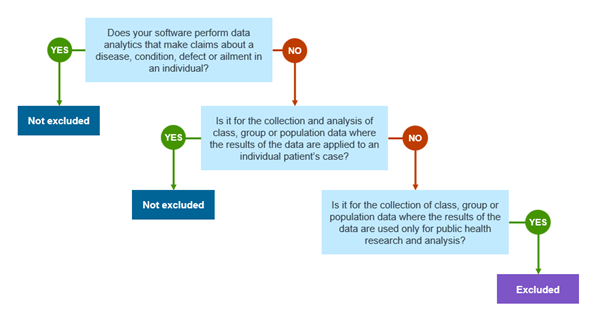

A decision flowchart that explains when software is excluded or not excluded based on how it analyses data and how the results are used.
The flowchart progresses through a series of yes‑or‑no questions, with each path ending in either "Excluded" or "Not excluded."
The process begins with the following question: "Does your software perform data analysis that makes claims about a disease, condition, defect or ailment in an individual?"
If the answer is YES, the software is not excluded, and the decision process ends.
If the answer is NO, the flow continues to the next question.
The second question is: "Is it for the collection and analysis of class, group or population data where the results of the data are applied to an individual patient's case?"
If the answer is YES, the software is not excluded, and the decision process ends
If the answer is NO, the flow continues to the next question.
The third question is: "Is it for the collection of class, group or population data where the results of the data are used only for public health research and analysis?"
If the answer is YES, the software is excluded.
If the answer is NO, no further path is shown and the exclusion outcome does not apply.
Overall, the diagram shows that software is not excluded when it makes claims about an individual's health or when population‑level data is used to inform individual patient cases.
Software may be excluded only when it is limited to the collection and analysis of population‑level data used solely for public health research and analysis.
Glossary
| Term | Definition |
|---|---|
| Perform data analytics | This means working with and using data to discover insights and support evidence-based decision making. Working with data can mean looking at, cleansing, transforming and re-organising data, so it is easier to use. Using data can mean interrogating the data and creating models to display information and insights. |
| Collection and analysis of class, group, or population data | This means collecting and analysing this data. If the collection and analysis is used to find trends only, for example to show results and patterns, then it is excluded from our regulations. For example, software may analyse aggregated, de-identified patient data for research purposes, or to inform public health measures, and where resources could most efficiently be used. This software would be excluded. |
| Individual patient's clinical case | If the data collection and analysis is used to inform clinical action in relation to the health of an individual patient, for example software that compares an individual’s information against aggregated data to screen for a disease, then the software is not excluded. |
| Make claims about a disease, condition, ailment or defect | If your software does any of the following:
…of a disease, condition, ailment, or defect, then it is not excluded. |
Page history
Published using selected content previously located in guidance titled 'Understanding if your software-based medical device is excluded from our regulation.'
Published using selected content previously located in guidance titled 'Understanding if your software-based medical device is excluded from our regulation.'