

Understanding the clinical workflow management software exclusion
Guidance on when software used for clinical workflow management may be excluded from our regulatory requirements.
Purpose
If you are a software developer, manufacturer or product sponsor it is your responsibility to check whether your software or digital product is excluded from our regulation before you release it for supply in Australia.
There are currently 15 excluded software categories listed in Schedule 1 of the Therapeutic Goods (Excluded Goods) Determination 2018 (the Determination).
This guidance relates to software used for clinical workflow management, which may be excluded from our regulation under item 14J of the Determination.
Legislation
Introduction
We regulate all software-based products in Australia that meet the definition of a medical device unless they meet one of 15 excluded software categories.
If your product meets the definition of a medical device in Section 41BD of the Therapeutic Goods Act 1989 it must be included on the Australian Register of Therapeutic Goods (ARTG) before it is marketed or supplied in Australia unless a valid exemption is in place.
However, clinical workflow management software could be excluded from our regulation under item 14J of the Determination.
Note: Software with multiple functions
Every feature of software with multiple functionalities must meet the exclusion criteria to qualify for an excluded software category.
About this exclusion category
Exclusion 14J applies to software that is for clinical workflow management.
Extract: Item 14J
Software that is:
intended by its manufacturer to be used for clinical workflow management; and
not intended by its manufacturer to diagnose, screen for, prevent, monitor, predict, make a prognosis of, alleviate, treat, or make a recommendation or decision about the treatment of, a disease, condition, ailment, or defect.
Check if your software is excluded
This exclusion is based on 2 questions.
If you answer YES to the following question, the exclusion may apply:
- Is your software for clinical workflow management?
If you answer YES to the following question, your software is not excluded:
- Does the software make claims about a disease, condition, ailment, or defect?
Flowchart for determining if software is excluded by 14J
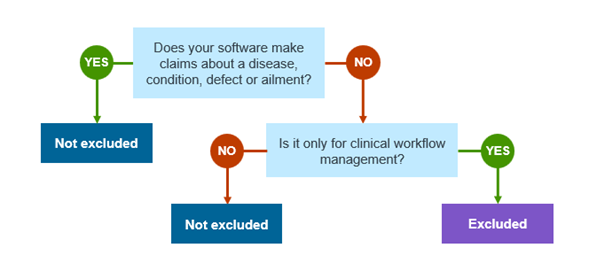

A decision pathway flowchart for excluded software category 14J.
This diagram presents a decision tree used to determine whether software is excluded under category 14J.
The decision process begins with the question: "Does your software make claims about a disease, condition, defect, or ailment?"
If the answer to this question is YES, the outcome is "Not excluded."
If the answer is NO, the process moves to a second question: "Is it only for clinical workflow management?"
If the answer to the second question is YES, the outcome is "Excluded."
If the answer to the second question is NO, the outcome is "Not excluded."
In summary, software is excluded under category 14J only when it does not make claims about a disease, condition, defect, or ailment and is used solely for clinical workflow management. In all other cases, the software is not excluded.
Examples
Excluded software
Example: Hospital admissions software
Software that runs a function that admits a patient to a hospital, according to that hospital’s standard procedures.
This software includes a series of steps such as recording observations about a patient's vital signs and tells a user what work to do according to an established procedure but not what decisions to make.
This software would be excluded from our regulation because it makes no claims about any diseases or conditions. It is not intended for treating, diagnosing, or monitoring diseases or conditions.
Not excluded
Example: Hospital admissions and screening software
Software that runs a function that admits a patient to a hospital and has options for a screening function for several diseases.
This software would not be excluded from our regulation because it has additional functionality compared to the first example. The user is given recommendations and suggestions, which means the software meets our definition of a software-based medical device.
Glossary
| Term | Definition |
|---|---|
| Clinical workflow management | Processes used in both administration and operations to make sure patients the best health experience possible. This term encompasses software designed to make the healthcare system (or elements of it) more efficient and streamlined. It connects activities, environments, organisations, people, and technologies in a clinical environment. Some of these might happen or work at the same time, while others might proceed in a logical order, one providing the information needed for the next to happen. It includes access to, and display of, a patient's digital medical history and/or peer reviewed clinical studies and clinical practice guidelines. Clinical workflow management develops patterns that can be relied upon, minimising the risk of mistakes and complications. |
| Make claims about a disease, condition, ailment or defect | If your software does any of the following:
…of a disease, condition, ailment, or defect, then it is not excluded. |
Page history
Published using selected content previously located in guidance titled 'Understanding if your software-based medical device is excluded from our regulation.'
Published using selected content previously located in guidance titled 'Understanding if your software-based medical device is excluded from our regulation.'