

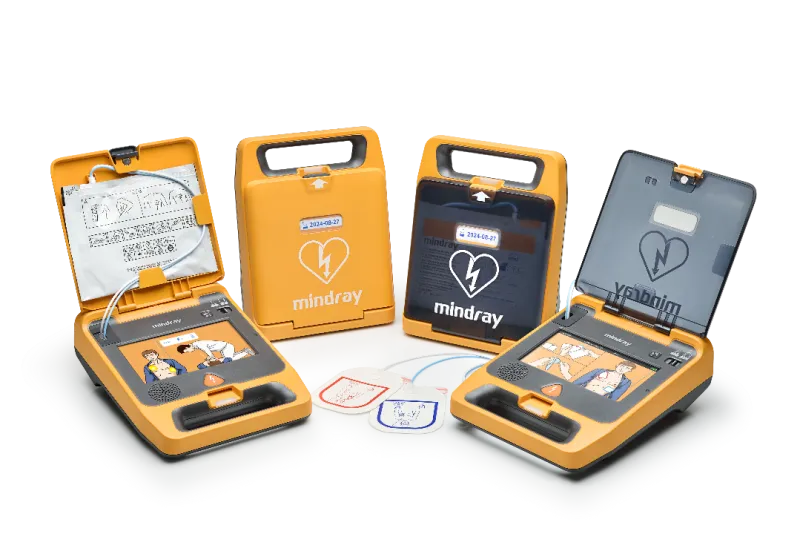
BeneHeart C Series AED: Non-rechargeable public automated external defibrillator
Mindray Medical Australia Pty Ltd is conducting a product correction for the BeneHeart C Series Automated External Defibrillator (AED).
The operator’s manual is being updated to help users better understand the impact of the Wi-Fi settings on battery life, and information on the electrode pads detection function.
Product details
| ARTG Number | Product | Model(s) |
|---|---|---|
| 166368 | BeneHeart C Series Automated External Defibrillator |
|
What is the problem?
Wi-Fi/Network configurations and battery life
When the equipment is configured with Wi-Fi/cellular turned on, it automatically sends self-test reports by default, which consume extra battery power. In some network configurations, this could lead to a shortened battery life.
Electrode pads in-position detection
The device automatically checks that new electrode pads have been attached after use, before shutdown. If new electrode pads aren’t connected, the status light on the device will flash red. The manual has been updated to make this information clearer.
What is the risk?
A low battery may cause the device to fail to power on leading to delayed therapy. If new electrode pads aren’t connected after use, this may also lead to a delay, as it must be resolved before delivering therapy. This may impact the effectiveness of resuscitation efforts.
What should I do?
- Review the new electronic manual supplied by Mindray Medical Australia.
- As outlined in the manual, if the on-screen battery symbol indicates battery power is low or almost depleted, replace the battery immediately.
- Contact Mindray Medical Australia to disable the automatic sending of self-test reports via WiFi/cellular, if this function is not needed.
- After patient therapy is complete, disconnect used electrode pads and plug in the pads connector of new electrode pads before turning off the equipment.
- The Mindray BeneHeart C Series AED can be used as per routine practice.
Further information
Please contact Mindray Medical Australia on 1800 793 011 or email service.au@message.mindray.com for further information.
Reporting problems
Consumers and health professionals are encouraged to report problems with medical devices. Your report will contribute to our monitoring of these products. For more information see the TGA Incident Reporting and Investigation Scheme (IRIS).
The TGA cannot give advice about an individual's medical condition. You are strongly encouraged to talk with a health professional if you are concerned about a possible adverse event associated with a medical device.