We’re experiencing issues with our datasets and search. We apologise for any inconvenience while we work to fix this.


Description
Oxaceprol is synthesised by transesterification of hydroxyproline and ethyl acetate catalysed by acyltransferase enzyme in a phosphate buffered saline (PBS) and ethanol as a solvent. Trans-N-acetyl-4-hydroxy-L-proline, the stable isomeric form of oxaceprol, is obtained which is air dried to yield the desired ingredient.
Structure:
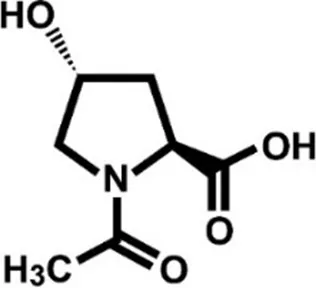
Molecular formula: C7H11NO4
Molecular weight: 173.17
CAS Number: 33996-33-7
| Test | Method reference | Acceptance criteria |
|---|---|---|
| CHARACTERISATION | ||
| General properties | ||
| Appearance | Visual | White to off-white powder or crystal |
| Bulk Density | USP <616> | 1.324 g/cm³ |
| Melting Point | USP <741> | 132°C |
| Solubility in water | USP <1236> | Freely soluble |
| Loss on Drying | USP <731> | <0.5% |
| Residue on Ignition | USP <281> | <0.2% |
| pH (2% aqueous solution, 25°C) | USP <791> | 1.5-2.5
|
| Specific Rotation [α]20D | USP <781> | 115-127 deg·mL·g−1·dm−1 |
| Identity | ||
| HPLC | HPLC[1] | Observation of peaks at retention time of 5.3 min ±3%. |
| NMR | USP <761> | Observation of signals at: 1H NMR (DMSO-d6): δ1.81, 1.85-1.92, 2.06-2.22, 3.35-3.29, 3.57, 4,17, 4.29, 5.06, 12.49 ppm 13C NMR (DMSO-d6): δ178.69, 174.24, 173.72, 73.96, 72.43, 63.41, 62.34, 60.62, 58.94, 42.77, 27.25, 26.60 ppm. |
| Elemental impurities | ||
| Lead | USP <233> | ≤2 ppm |
| Arsenic | USP <233> | ≤0.5 ppm |
| Mercury | USP <233> | ≤0.1ppm |
| Cadmium | USP <233> | ≤0.1 ppm |
| Nickel | USP <233> | ≤10 ppm |
| Antimony | USP <233> | ≤0.5 ppm |
| Chromium | USP <233> | ≤5 ppm |
| Iron | USP <233> | ≤20 ppm |
| Copper | USP <233> | ≤20 ppm |
| Residual Solvents | ||
| Ethanol | USP <467> | <100 ppm |
| Ethyl acetate | USP <467> | <100 ppm |
| Other organic or inorganic impurities | ||
| Acyltransferase enzyme | GC[2] | <1 ppb |
| Microbiology | ||
| While substance manufacturers are encouraged to include limits for objectionable microorganisms, it is the product into which those substances are formulated that is subject to a legally binding set of criteria. The Therapeutic Goods Order No. 100 'Microbiological Standards for Medicines' mandates that any finished product that contains the ingredient, alone or in combination with other ingredients, must comply with the microbial acceptance criteria set by Clause 11 of the Order. | ||
Footnotes
HPLC: Column: Welch Ultimate Series XB-C18 (250 mm x 4.6 mm, 5μm) and Agilent Zorbax SB-C18 (250 mm x 4. 6 mm, 5μm); Injection volume: 10-20μL; Column temperature: 35°C; Flow rate: 1.0 mL/min. Run time: 30 min; Mobile phase A: Acetonitrile; Mobile Phase B: 0.1% Formic acid solution; UV detector wavelength: 210 nm. Gradient HPLC conditions (0-10 min: 2% A → 15 min: 10% A → 20-25 min: 2% A).
GC: Column: Agilent 19091J-413 HP-5 (30 m x 320 μm x 0.25 μm); Inlet temperature: 150°C; Detector: Hydrogen flame ionisation; Detector temperature: 300°C; Flow rate: 1.0 mL/min; Split ratio: 50:1; Carrier gas: Nitrogen; Program: starting at 40°C, maintain for 10 minutes → ramp up to 100°C at a rate of 5°C per minute → to 200°C at a rate of 30°C per minute → maintain for 5 minutes; Injection method: Headspace injection; Headspace bottle equilibrium temperature: 60°C, Quantitative loop temperature: 100°C; Transmission line temperature: 120°C, Balance time: 30 min; GC cycle time: 40 min.
Abbreviations
CAS = Chemical Abstract Services
GC = Gas chromatography
HPLC = High Performance Liquid Chromatography
NMR = Nuclear magnetic resonance
ppm = parts per million
USP = United States Pharmacopeia