

Pharmacovigilance Inspection Program metrics report: January 2023 to December 2024
Introduction
Purpose of this report
This report summarises the outcomes of the Pharmacovigilance Inspection Program (PVIP) conducted by the Therapeutic Goods Administration (TGA) in the 2-year period, from January 2023 to December 2024. The deficiencies identified are presented along with case studies of critical deficiencies from this reporting period, to support medicine sponsors in the continual improvement of their pharmacovigilance systems. In addition, the report discusses trends over time and helps sponsors to prepare for a pharmacovigilance inspection.
Background
Since 2017, the PVIP has strengthened the TGA’s post-market monitoring of medicines and vaccines included on the Australian Register of Therapeutic Goods (ARTG).
Sponsors of medicines and vaccines are required to create and maintain an effective pharmacovigilance system. Pharmacovigilance inspections enable the TGA to review the system implemented by the sponsor, verify compliance and deliver education to help sponsors to meet their pharmacovigilance obligations.
In this report we use ‘must’ or ‘required’ to describe a sponsor’s legal obligations. We use ‘should’ to describe actions that assist sponsors to meet their legal requirements.
The TGA’s pharmacovigilance inspectors verify sponsor compliance with legislated reporting and record-keeping requirements, in addition to the recommendations set out in the guidance document, Pharmacovigilance responsibilities of medicine sponsors, Australian recommendations and requirements (referred to as the Pharmacovigilance Guidelines).
For further information about the PVIP including how we prioritise and conduct inspections and our approach to compliance and enforcement, please refer to: Pharmacovigilance inspection program: Guidance for medicine sponsors.
Appendix I explains the 9 pharmacovigilance inspection topic areas which may be reviewed during an inspection. A maximum of 9 deficiencies, one per topic area, may be identified in an inspection. A deficiency against a topic area can comprise multiple identified incidents of non-compliance, and consideration of the cumulative pharmacovigilance impact determines the overall grading of the deficiency. Definitions of deficiency gradings are provided in Appendix II.
During this reporting period, the scope of the topic area previously called Management of Significant Safety Issues changed following the August 2023 revision of the Pharmacovigilance Guidelines. The topic area was renamed Management of Safety Issues to include the new requirements and recommendations for both significant safety issues and other safety issues. Sponsors were granted a six-month implementation period, to 31 January 2024, before we assessed compliance against the newly introduced requirements and recommendations.
Inspections conducted in this reporting period
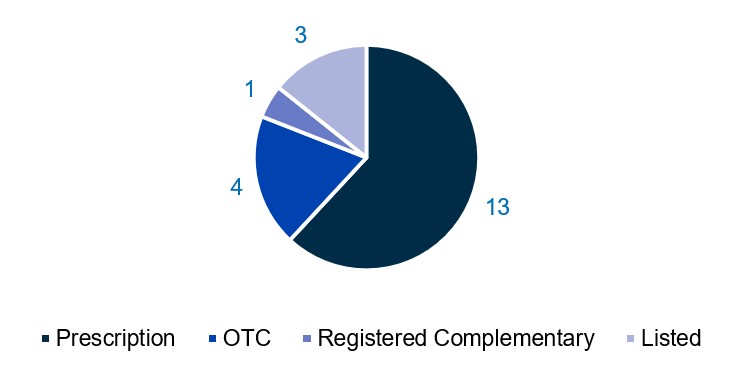
From 1 January 2023 to 31 December 2024, the TGA conducted 14 pharmacovigilance inspections of Australian medicine sponsors.
The 14 inspections involved sponsors of a range of medicine types registered (prescription, over-the-counter [OTC] & registered complementary) and listed on the ARTG as presented in Figure 1 below.
Deficiencies identified during the reporting period
Summary of deficiencies
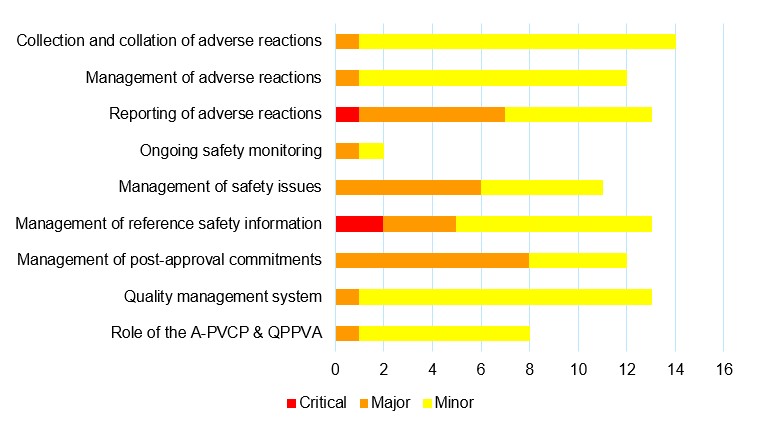
During the reporting period, 14 inspections resulted in the identification of:
- 3 critical deficiencies
- 28 major deficiencies
- 67 minor deficiencies.
The number of deficiencies identified per inspection ranged from 5 to 8. There was no correlation between the number of deficiencies and the severity of the grading of the deficiencies. The number and grading of all deficiencies by topic area is presented in Figure 2.
Comparison of inspection deficiencies over time (2018 - 2024)
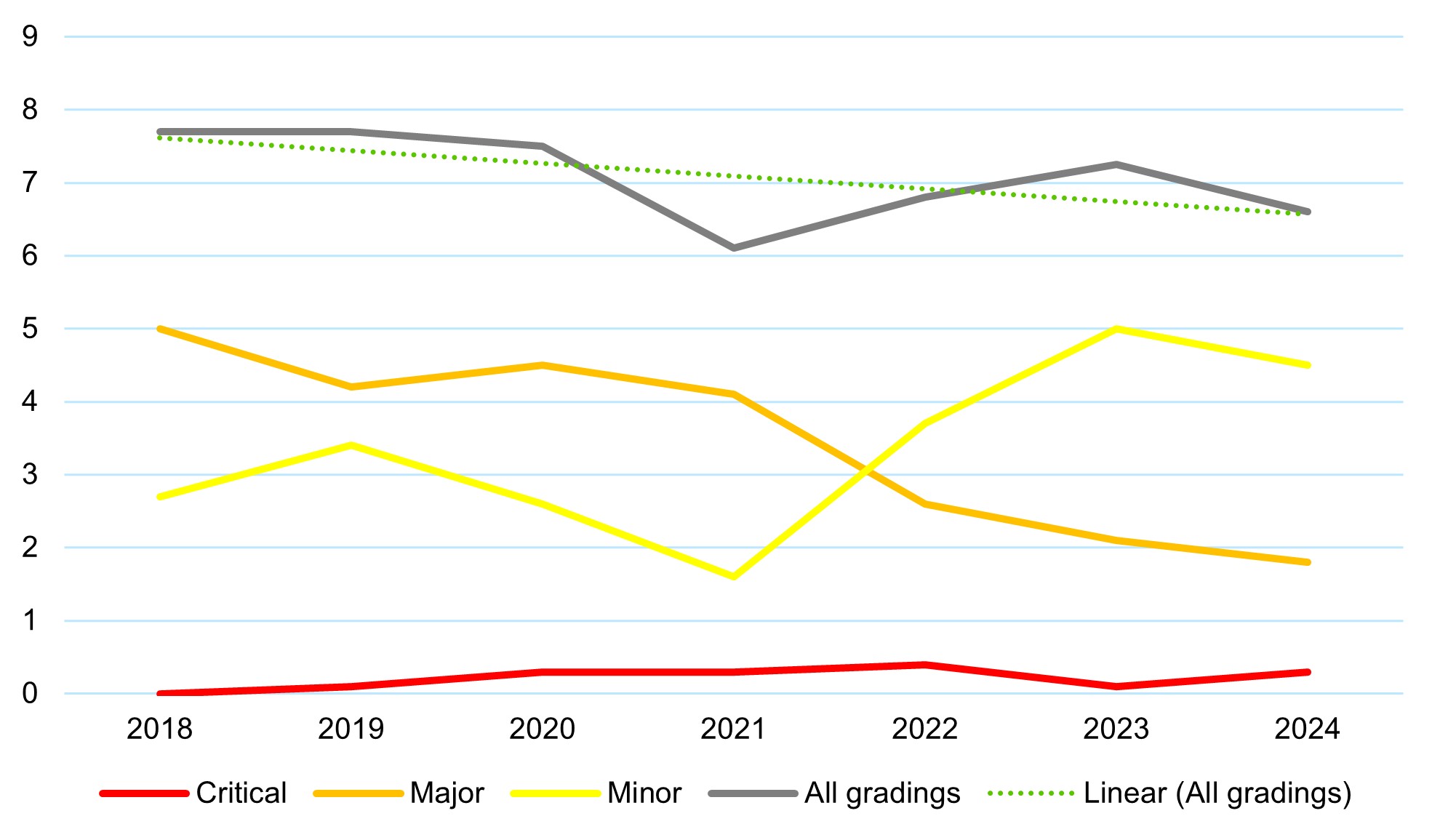
- The average number of deficiencies per inspection has slightly decreased over time, since 2018
- Overall, the severity of non-compliance identified in inspections has decreased over time, since 2018
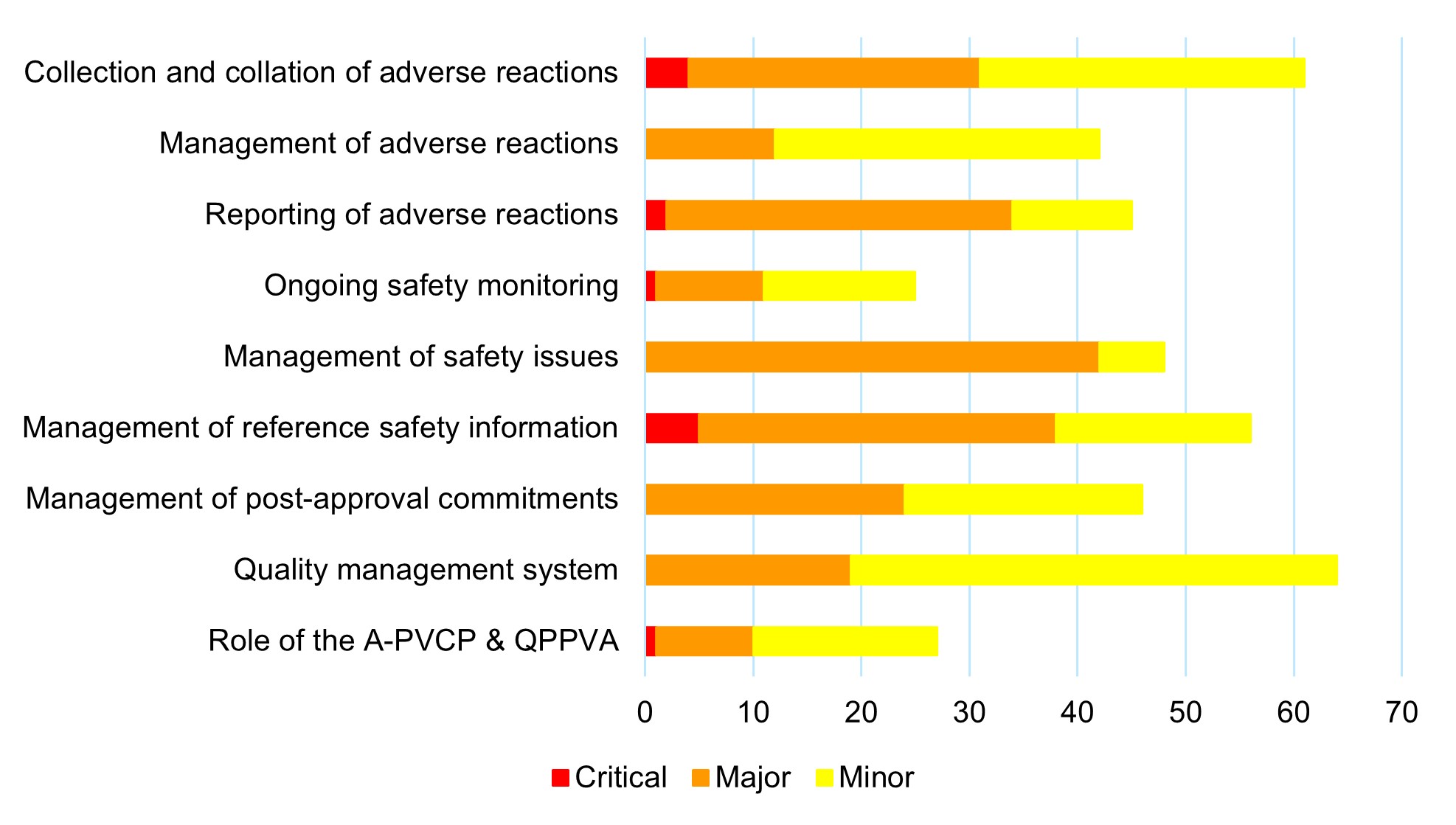
- The topic area, Management of reference safety information is associated with the greatest number of critical deficiencies since 2018
- The distribution of major and minor deficiencies across the 9 topics areas remains relatively consistent over time, since 2018.
Figure 3 presents the average number of deficiencies identified per inspection, since the first inspection conducted through the PVIP in 2018.


Summary
Analysis of the average inspection deficiencies per inspection over a 7-year period since the commencement of the program in 2018, as presented in Figure 3, suggests a sustained improvement in sponsor adherence to pharmacovigilance requirements and recommendations. Over time, both the frequency and severity of identified deficiencies have declined. The latter driven by a decrease in the number of major deficiencies.
Whilst the number of critical deficiencies identified per reporting period has remained relatively constant over the 7-year period, this number has remained low and represents only 3% of total deficiencies identified through the PVIP.
Appendix I: Inspection topic areas
| Topic area | Aspects of the pharmacovigilance system reviewed |
|---|---|
| Collection and collation of adverse reactions | Collection of spontaneous sources of safety data, including medical information, product quality complaints, medical literature, company personnel, social and digital media etc. |
| Collection of solicited sources of safety data, including patient support and market research programs, post-registration studies etc. | |
| Collation of safety data to facilitate effective ongoing monitoring | |
| Management of adverse reactions | Case processing e.g. duplicate checks, data entry, quality control and assurance, coding, causality and seriousness assessment |
| Follow up, including use of targeted follow up questionnaires (if applicable) | |
| Management of invalid cases | |
| Management of special situation reports | |
| Reporting of adverse reactions | Reporting of initial and follow up serious adverse reaction reports to the TGA |
| Ongoing safety monitoring | Signal detection and assessment |
| Management of safety issues | Identification and receipt timeline of Significant Safety Issues and Other Safety Issues by the sponsor |
| Recording of assessment decision of safety issues as SSI and OSIs | |
| Reporting timeframes for SSI and OSIs | |
| Management of reference safety information | Maintenance of Australian PI, CMI, product packaging leaflets and product labelling (as applicable) |
| Maintenance of safety-related information in company-sponsored material (e.g., educational, or promotional items) | |
| Communication of updated safety-related information to internal and external stakeholders | |
| Management of post-approval commitments | Submission of PSURs |
| Maintenance and submission of RMPs/ASAs | |
| Compliance with RMP/ASA commitments | |
| Oversight of and compliance with other pharmacovigilance related conditions of registration | |
| Quality management system | Management and retention of pharmacovigilance records |
| Pharmacovigilance training | |
| Implementation and management of pharmacovigilance procedures | |
| Audit and deviation management | |
Implementation and maintenance of safety data exchange agreements, pharmacovigilance agreements and pharmacovigilance clauses in other agreements. Completeness of agreements and compliance with the agreed pharmacovigilance responsibilities. | |
| Oversight of third parties and vendors | |
| Role of the A-PVCP & QPPVA | Notification of the A-PVCP, including updates |
| QPPVA oversight of the pharmacovigilance system including involvement and awareness of product-specific issues |
Appendix II: Inspection deficiency gradings
Excerpt from the Pharmacovigilance inspection program: Guidance for medicine sponsors.
Critical deficiency:
A deficiency in pharmacovigilance systems, practices or processes that adversely affects the rights, safety or well-being of patients or that poses a potential risk to public health or that represents a serious violation of applicable legislation and guidelines.
Deficiencies classified as critical may include a pattern of deviations classified as major.
A critical deficiency also occurs when a sponsor is observed to have engaged in fraud, misrepresentation or falsification of data.
Major deficiency:
A deficiency in pharmacovigilance systems, practices or processes that could potentially adversely affect the rights, safety or well-being of patients or that could potentially pose a risk to public health or that represents a violation of applicable legislation and guidelines.
Deficiencies classified as major may include a pattern of deviations classified as minor.
Minor deficiency:
A deficiency in pharmacovigilance systems, practices or processes that would not be expected to adversely affect the rights, safety or well-being of patients.
A deficiency may be minor either because it is judged as minor or because there is insufficient information to classify it as major or critical.
Note:
Deficiencies are classified by the assessed risk level and may vary depending on the nature of medicine. In some circumstances an otherwise major deficiency may be categorised as critical.
A deficiency reported after a previous inspection and not corrected may be given higher classification.
Comments (observations) may be included in the inspection report and are not discussed here in this report. Comments are not deficiencies but might lead to suggestions on how to improve quality or reduce the potential for a deviation to occur in the future.