

Finding and understanding Unique Device Identifiers (UDI)
Learn how to find and understand a Unique Device Identifier (UDI).
Understanding UDIs
A UDI is a series of letters, numbers or symbols that are used to identify a medical device.
A UDI has 2 parts:
- the Device Identifier (UDI-DI), which identifies the model of device
- the Production Identifier (UDI-PI), which identifies production details, such as the serial number or expiry date.
Example of the UDI-DI and UDI-PI forming a full UDI and how a UDI in HRI and AIDC forms create a UDI Carrier.
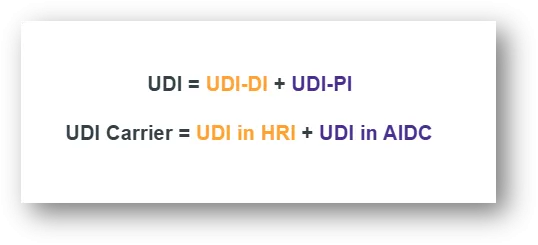
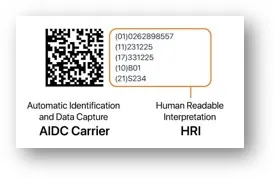
Where a device has a UDI, you will see it in human-readable text and in machine-readable form, such as a barcode. This ensures that the device can be read by humans and machines.
Example of a two-dimensional Data Matrix barcode with adjacent human readable interpretation (HRI), showing the information as text.
Some devices, like those sold in retail, may have slightly different UDI labels. This is because UDI requirements are tailored for the way a device is supplied.
In this example, the full UDI is shown.
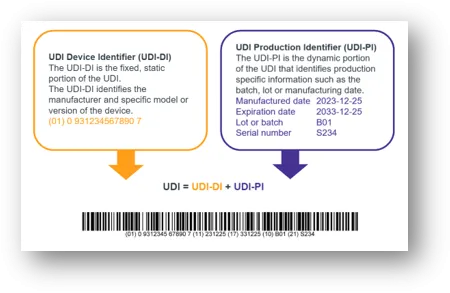
The UDI-DI identifies the device model. The UDI-PI contains information about the specific device, such as its expiry date, lot or batch number and serial number. Together, these form the full UDI.
An example of a UDI. The UDI-DI and UDI-PI are combined to form the full UDI. The UDI is the fixed, static portion of the UDI. The UDI-PI is the dynamic portion of the UDI that identifies production information such as batch number or manufacturing date.
Example of a medical device label with a UDI:
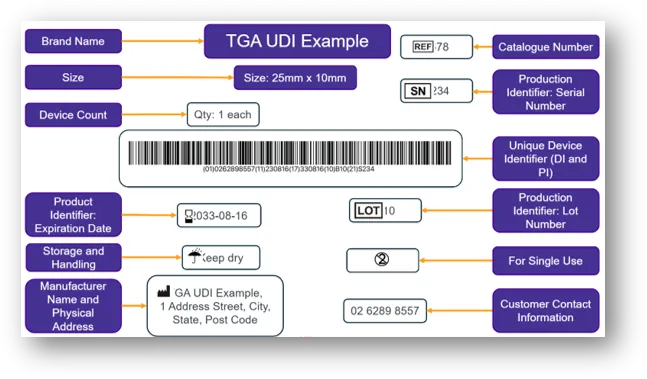
These images demonstrate what a UDI may look like and explain how to understand the information on a UDI label.
Finding a UDI
You can find the UDI on the device itself, the device label or device packaging.
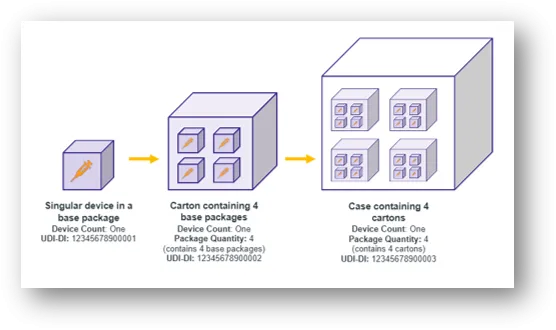
If the device has higher levels of packaging, the UDI on that higher level is called a Package DI.
- The Primary DI is the UDI-DI you find on the device label or lowest level of packaging.
- Package DI(s) are UDI-DIs you find on higher levels of packaging, such as boxes or cartons.
This means that the UDI on the device package may be different from the UDI on the carton the device came in.
Diagram showing packaging hierarchy for medical devices. Each level includes device count and package details, with arrows indicating progression from smallest to largest package.
You may see or use a UDI when:
- receiving or managing stock
- preparing a device for use
- using or implanting a device during patient care
- recording device information in records
- investigating a safety issue or recall.
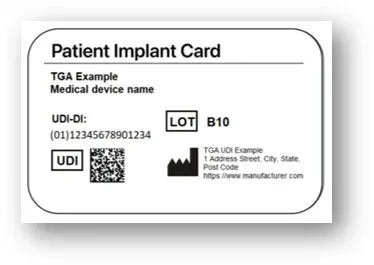
If you implant a medical device, you may find the UDI information on the patient implant card, be required to put the UDI in the patient discharge information or medical record.
An example of a Patient Implant Card (PIC) displaying the Unique Device Identifier (UDI) in Automatic Identification and Data Capture (AIDC) and the UDI Device Identifier (UDI-DI) in Human Readable Interpretation (HRI).
Depending on the device, you may find the UDI on the device, its label, individual packaging or higher levels of packaging such as cartons.
Both the Primary DI and any Packaging DIs are specific to a model of medical device, meaning you can identify the device even where it has additional packaging.
You may also come into contact with UDIs at different stages during in your work, depending on your role and the healthcare setting.
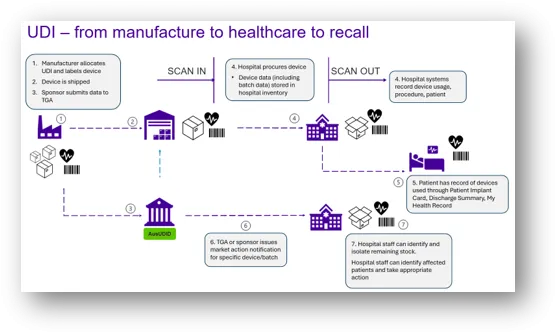
UDIs are allocated by manufacturers and included on device labels and submitted to the TGA. Devices are shipped to a healthcare organisation who record the UDI in inventory. If the UDI is recorded at the time of use on a patient it can be looked up again if a device is subject to a market action.
Example of a UDI that maybe found in healthcare:

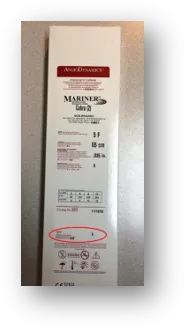
Example of a higher level of packaging:
Looking up a medical device
You can search the Australian UDI Database (AusUDID) for information about medical devices. The AusUDID does not store patient information.
For detailed information on using the AusUDID please see: