

Benefits of UDI in healthcare
Learn how UDI can enable improved patient safety, support recalls and adverse event management, and enhance device traceability across the healthcare system.
Unique Device Identification (UDI) is a foundation for safer, more reliable use of medical devices across healthcare. For healthcare organisations, the value of UDI is practical: it helps staff identify the right device, record it consistently, locate affected products quickly, and connect device information to patient care, recalls, adverse event reporting, registries and supply chain processes.
The full benefits of UDI are realised when UDI is adopted within healthcare organisation systems and processes and within relevant clinical quality registries.
UDI underpins several important activities that directly deliver improved patient safety outcomes, including:
- involving and informing patients about the medical devices used in their care
- improving supply chain visibility and management to support device availability
- enabling timely identification of alternative products during supply chain disruptions
- supporting accurate device identification in adverse event reports
- enabling timely, effective and comprehensive market actions, including recalls
- supporting accurate analysis of device performance and patient outcomes through consistent device identification.
Benefits of UDI
While the primary benefit of the UDI system is improved patient safety, additional benefits include:
- improved traceability of medical devices, enabling faster identification of affected devices and patients during recalls, device failures and serious adverse events
- support for clinical workflows, such as theatre preparation and inventory management, by helping prevent the use of recalled, expired or incorrect devices
- more efficient billing and reimbursement processes through accurate device identification and automated data capture
- increased transparency through public access to current medical device information in the Australian UDI Database (AusUDID).
Benefits for clinical care
UDI supports safer and more efficient patient care by:
- enabling accurate identification of medical devices used during a patient's treatment
- reducing the time spent identifying devices and managing inventory, allowing clinicians to spend more time providing patient care
- providing patients with reliable information about the devices used in their care
- reducing manual documentation and transcription errors through point-of-care data capture
- supporting faster and more accurate identification of patients affected by recalls.
Benefits for supply chain management
UDI can improve supply chain visibility, efficiency and resilience by:
- supporting standardised and automated device documentation
- improving the consistency, accuracy and visibility of inventory data
- enabling more effective inventory management based on real-time usage data
- reducing stock shortages and excess inventory
- providing a consistent approach to procurement and contracting
- helping identify counterfeit products
- supporting preparedness for emergency and surge-response situations
- reducing staff workload through process automation
- enabling rapid identification and removal of recalled devices from the supply chain.
Benefits for finance and revenue management
UDI can support financial management by:
- providing accurate and timely device information for charge capture and billing
- reducing revenue leakage
- decreasing administrative effort
- supporting reimbursement activities
- improving the quality of data used for cost, value and comparative effectiveness assessments.
Benefits for real-world evidence and research
UDI enables consistent device identification across datasets, supporting:
- linkage of clinical, registry, payer, manufacturer and patient data
- generation of real-world evidence on medical device performance
- improved decision-making by healthcare providers, regulators, manufacturers and patients
- benchmarking and analysis of costs and outcomes
- identification of opportunities for quality improvement and optimisation.
Benefits for adverse event reporting and patient safety
UDI strengthens post-market monitoring and safety activities by:
- supporting more accurate and reliable adverse event reporting
- improving the quality of safety investigations
- enabling consistent identification of devices in safety alerts and recall communications
- supporting more timely and targeted patient safety actions.
UDI across the device lifecycle
UDI has the potential to deliver value throughout the lifecycle of a medical device. Benefits begin during manufacture and continue through distribution, procurement, storage, clinical use and patient care.
UDI also plays an important role in post-market activities, including adverse event reporting, recall management and assessment of device performance.
The below image shows the vision for UDI adoption in Australian healthcare.
Figure 1: Vision for UDI adoption in Australian healthcare
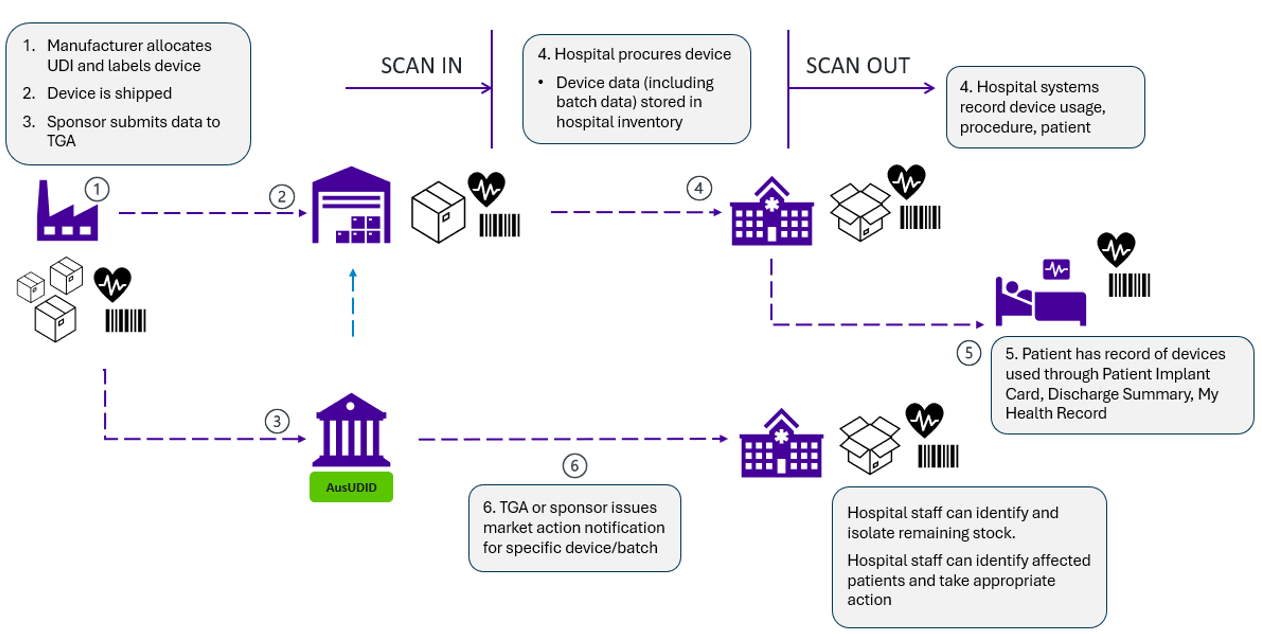

UDIs are allocated by manufacturers and included on device labels and submitted to the TGA. Devices are shipped to a healthcare organisation who record the UDI in inventory. If the UDI is recorded at the time of use on a patient it can be looked up again if a device is subject to a market action.
Page history
Original publication
Original publication