

Overview of UDI in Australian healthcare
Learn about Australia's Unique Device Identification (UDI) system, its purpose, and how it supports safer and more effective healthcare.
The Australian Unique Device Identification (UDI) system
The Australian UDI system has 2 key components:
- placing Unique Device Identifiers (UDIs) on medical device labels and packaging
- submitting the UDI-Device Identifier (UDI-DI) and related device information to the Australian UDI Database (AusUDID), where healthcare professionals, patients, and consumers can access it.
Unique Device Identifiers (UDIs)
A Unique Device Identifier (UDI) is a series of numeric or alphanumeric characters allocated to a specific model of medical device through a globally accepted standard.
A UDI has 2 parts:
- UDI-Device Identifier (UDI-DI): The fixed part that identifies a specific model or version of a medical device.
- UDI-Production Identifier (UDI-PI): The dynamic, variable part that identifies the production details of a device.
UDIs are applied to medical device labels and packaging in the form of a UDI Carrier. The UDI Carrier contains the UDI in both human-readable and machine-readable formats.
UDIs can support identification of medical devices throughout the supply chain, across healthcare systems and within patient records.
Australian UDI Database (AusUDID)
The AusUDID is a free public database that provides information about medical devices approved for supply in Australia.
You can access the AusUDID here: TGA AusUDID.
Healthcare professionals can use the AusUDID to:
- search for medical devices using a UDI, brand name, manufacturer, or other keyword
- access key device information, including clinical characteristics and manufacturer details
- view Patient Information Leaflets (PILs) or Instructions for Use (IFUs), where available.
Note
The AusUDID does not store patient information or commercially confidential information.
AusUDID device information is maintained by sponsors and manufacturers.
Phased introduction of UDI in Australia
We have introduced UDI requirements in Australia through a phased implementation approach. Mandatory compliance with UDI requirements began on 1 July 2026 for high-risk medical devices and will progressively apply to other device classes until 30 June 2030.
The diagram below outlines the implementation timeframes and compliance dates for industry.
Figure 1: UDI industry compliance timeframe
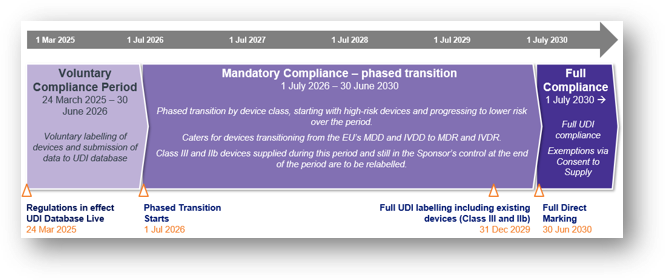

UDI requirements will be introduced in phases based on device risk class. Mandatory compliance for Class III and IIb devices begins on 1 July 2026. Full compliance for UDI labelling of all device classes will be complete by 31 December 2029. Full compliance for direct marking is by 30 June 2030. Exemptions can be sought through Consent to Supply.
As UDI requirements now apply to some medical devices, healthcare organisations will see more UDIs on medical device labels and increasing numbers of UDI records in the AusUDID.
Some devices that are not due to be compliant in Australia yet may already display a UDI. This could be because they are compliant with UDI requirements in other jurisdictions, such as the United States (US) or the European Union (EU). The Australian UDI framework recognises US and EU UDI-compliant labels, allowing manufacturers to use the same UDI across multiple markets. This supports global harmonisation and improves device traceability.
Some of these devices may not have a corresponding UDI record in the AusUDID. This could be because the device is not subject to Australian UDI requirements, or because the compliance date for that device classification has not yet been reached.
UDI requirements for healthcare providers
At the time of publication, there are no mandatory requirements for healthcare providers to adopt UDI.
We are working with the Australian Commission on Safety and Quality in Health Care to consider inclusion of UDI in the 3rd edition of the National Safety and Quality Health Service (NSQHS) Standards, due for release in 2028-29.
Page history
Original publication
Original publication