
Introduction
Purpose of this report
This report summarises the outcomes of the Pharmacovigilance Inspection Program (PVIP) conducted by the Therapeutic Goods Administration (TGA) in the 2-year period, from January 2023 to December 2024. The deficiencies identified are presented along with case studies of critical deficiencies from this reporting period, to support medicine sponsors in the continual improvement of their pharmacovigilance systems. In addition, the report discusses trends over time and helps sponsors to prepare for a pharmacovigilance inspection.
Background
Since 2017, the PVIP has strengthened the TGA’s post-market monitoring of medicines and vaccines included on the Australian Register of Therapeutic Goods (ARTG).
Sponsors of medicines and vaccines are required to create and maintain an effective pharmacovigilance system. Pharmacovigilance inspections enable the TGA to review the system implemented by the sponsor, verify compliance and deliver education to help sponsors to meet their pharmacovigilance obligations.
In this report we use ‘must’ or ‘required’ to describe a sponsor’s legal obligations. We use ‘should’ to describe actions that assist sponsors to meet their legal requirements.
The TGA’s pharmacovigilance inspectors verify sponsor compliance with legislated reporting and record-keeping requirements, in addition to the recommendations set out in the guidance document, Pharmacovigilance responsibilities of medicine sponsors, Australian recommendations and requirements (referred to as the Pharmacovigilance Guidelines).
For further information about the PVIP including how we prioritise and conduct inspections and our approach to compliance and enforcement, please refer to: Pharmacovigilance inspection program: Guidance for medicine sponsors.
Appendix I explains the 9 pharmacovigilance inspection topic areas which may be reviewed during an inspection. A maximum of 9 deficiencies, one per topic area, may be identified in an inspection. A deficiency against a topic area can comprise multiple identified incidents of non-compliance, and consideration of the cumulative pharmacovigilance impact determines the overall grading of the deficiency. Definitions of deficiency gradings are provided in Appendix II.
During this reporting period, the scope of the topic area previously called Management of Significant Safety Issues changed following the August 2023 revision of the Pharmacovigilance Guidelines. The topic area was renamed Management of Safety Issues to include the new requirements and recommendations for both significant safety issues and other safety issues. Sponsors were granted a six-month implementation period, to 31 January 2024, before we assessed compliance against the newly introduced requirements and recommendations.
Inspections conducted in this reporting period
From 1 January 2023 to 31 December 2024, the TGA conducted 14 pharmacovigilance inspections of Australian medicine sponsors.
The 14 inspections involved sponsors of a range of medicine types registered (prescription, over-the-counter [OTC] & registered complementary) and listed on the ARTG as presented in Figure 1 below.
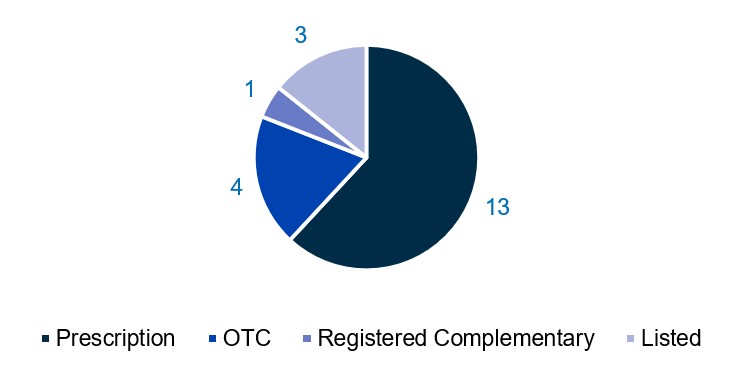
Figure 1. Medicine types included in inspections conducted in the reporting period
Figure 1 is a pie chart that shows prescription medicines dominate inspections (13), making up the majority. OTC medicines (4) form a smaller share, while listed (3) and registered complementary medicines (1) are included only in minor amounts. Overall, inspections are heavily focused on prescription medicines.
Inspections conducted in this reporting period continued
Some sponsors were responsible for a range of medicine types and therefore a single inspection sometimes included more than one medicine type. Four inspections included generic medicines, and one inspection concerned a sponsor of listed medicines only.
Thirteen inspections were routine system-related inspections. The remaining inspection was a re-inspection and involved a targeted review of updates to the sponsor’s pharmacovigilance system following a previous critical deficiency to verify the effectiveness of the corrective and preventative actions implemented by the sponsor.
Six inspections were conducted remotely via video conference, and 8 inspections were conducted via a hybrid format with a mix of on-site and remote days. Inspection duration ranged from 3 to 5 business days.
All non-compliance identified in the 14 inspections was addressed by sponsors in a timely manner via the implementation of a corrective and preventative action plan. No enforcement action was undertaken by the TGA as an outcome of any inspection conducted during this reporting period.
Deficiencies identified during the reporting period
Summary of deficiencies
During the reporting period, 14 inspections resulted in the identification of:
- 3 critical deficiencies
- 28 major deficiencies
- 67 minor deficiencies.
The number of deficiencies identified per inspection ranged from 5 to 8. There was no correlation between the number of deficiencies and the severity of the grading of the deficiencies. The number and grading of all deficiencies by topic area is presented in Figure 2.
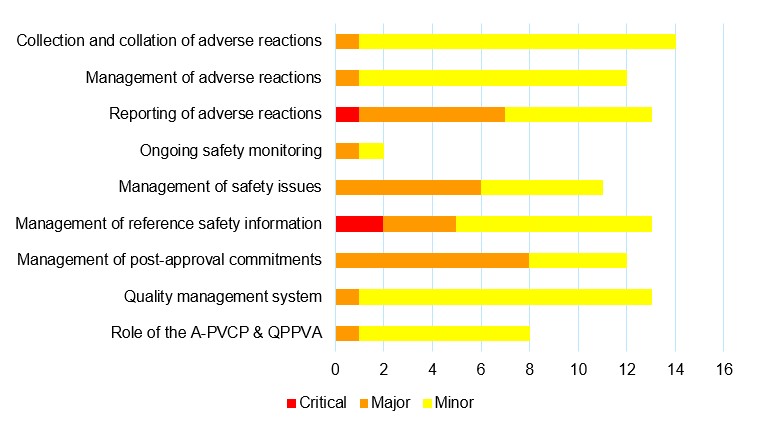
Figure 2. Number and grading of deficiencies by topic area for 2023-2024
Figure 2. shows a stacked horizontal bar chart illustrating the number and severity of deficiencies across different pharmacovigilance (PV) topic areas. Each bar is divided into three coloured segments:
- Red = Critical deficiencies
- Orange = Major deficiencies
- Yellow = Minor deficiencies
The horizontal axis represents the total count of deficiencies, ranging roughly from 0 to about 16.
- Collection and collation of adverse reactions
- Total: 14 deficiencies
- Mostly minor, with a small number of major
- No visible critical issues
- Management of adverse reactions
- Total: 12 deficiencies
- Again dominated by minor
- Small contribution from major deficiencies
- Reporting of adverse reactions
- Total: 13 deficiencies
- Mix of all three severities:
- Critical (small red segment)
- Significant major
- Large minor
- Ongoing safety monitoring
- Total: 2 deficiencies
- Very low overall
- Mostly minor, minimal major, no critical
- Management of safety issues
- Total: 11 deficiencies
- Combination of major and minor
- No visible critical deficiencies
- Management of reference safety information
- Total: 13 deficiencies
- Includes:
- Some critical
- Moderate major
- Large minor
- Management of post-approval commitments
- Total: 12 deficiencies
- Primarily major deficiencies
- Some minor, no critical indicated
- Quality management system
- Total: 13 deficiencies
- Mostly minor
- Small major component
- Role of the A-PVCP & QPPVA
- Total: 8 deficiencies
- Mostly minor, with some major
- No critical issues
Summary of deficiencies continued
In this reporting period, a total of 98 deficiencies were identified with the majority of those (67) graded as minor.
Three critical deficiencies were identified across 3 inspections; two inspections involved sponsors of generic medicines and one inspection concerned a sponsor of listed medicines. The critical deficiencies are discussed in more detail later (Critical deficiencies: case studies).
The greatest incidence of deficiencies (14) was identified in the topic area Collection and collation of adverse reactions. A deficiency in this topic area was identified in every inspection. However, nearly all these deficiencies were graded as minor with no critical deficiency attributed.
Deficiencies attributed to the topic areas of Quality management system (13), Management of adverse reactions (12) and Role of the A-PVCP & QPPVA (8) were also frequently identified, however graded as mostly minor with no critical deficiencies. This indicated common but less severe non-compliance for these aspects of the pharmacovigilance systems inspected.
Three topic areas were associated with 54% of all minor deficiencies identified in this reporting period: Collection and collation of adverse reactions (13), Quality management system (12) and Management of adverse reactions (11) and the key themes and common examples of non-compliance that comprised those major deficiencies are summarised in Table 1.
| Topic area | Common areas of non-compliance | Examples of non-compliance identified |
|---|---|---|
| Collection and collation of adverse reactions | Reconciliation |
|
| Collection of safety information |
| |
| Procedures |
| |
| Contact channels |
| |
| Pharmacovigilance Agreements and Contracts* |
| |
| Quality management system | Pharmacovigilance training |
|
| Procedures |
| |
| Pharmacovigilance record-keeping |
| |
| Pharmacovigilance Agreements and Contracts* |
| |
| Management of adverse reactions | Follow up |
|
| Identification and recording of safety information |
| |
| Data entry |
|
*Deficiencies pertaining to Pharmacovigilance Agreements and Contracts are commonly categorised into the topic area of Quality management system, however they may also be reported in any of the 8 other topic areas, based on the specific nature of the non-compliance.
Three topic areas were associated with 71% of all major deficiencies identified in this reporting period: Management of post-approval commitments (8), Reporting of adverse reactions (6) and Management of safety issues (6) and the key themes and common examples of non-compliance that comprised those major deficiencies are summarised in Table 2 below.
| Topic area | Common areas of non-compliance | Examples of non-compliance identified |
|---|---|---|
| Management of post-approval commitments | Risk Management Plan and Australian Specific Annex |
|
| Notification of commencement of supply |
| |
| Periodic Safety Update Reports |
| |
| Reporting of adverse reactions | 15-day reporting timeframe |
|
| Procedure |
| |
| Management of safety issues | Procedure |
|
| Reporting timeframes |
|
A deficiency associated with the topic area of Management of reference safety information was identified in 13 of the 14 inspections conducted in this reporting period. The 2 critical deficiencies are discussed separately (Critical deficiencies: case studies). The key themes associated with the 3 major and 8 minor deficiencies for this topic area are summarised in Table 3.
| Topic area | Common areas of non-compliance | Examples of non-compliance identified |
|---|---|---|
| Management of reference safety information | Delays |
|
| Procedure |
| |
| Misalignment |
|
Critical deficiencies: case studies
Critical deficiency #1
Topic area: Deficiencies in the management of reference safety information
Sponsor company was an Australian subsidiary of a global pharmaceutical company with a focus on generic medicines. The inspection was a routine system-based inspection of the sponsor’s pharmacovigilance system and compliance across all 9 inspection topic areas was reviewed.
The inspection revealed that all applications for safety related updates to generic medicine Product Information (PI) to align with the innovator PI submitted to the TGA in a 2-year review period, were submitted with a delay.
The safety-related PI updates were significant and included additional warnings and precautions, additional interactions and additional adverse reactions. All medicines were supplied in Australia at the time of the non-compliance.
We also identified evidence of delays with sponsor lodgement of updated PIs and Consumer Medicine Information (CMI) on the TGA website following the TGA’s approval of the associated updated PI.
Deficiencies were identified with the sponsor’s written procedure for this aspect of the pharmacovigilance system including, gaps in the process, absence of timelines for required actions, insufficient tracking and oversight.
The evidence of systemic delayed updates of reference safety information for sponsor medicines presented pattern of deviations classified as major and therefore a serious violation of applicable legislation and guidelines.
It is necessary that current reference safety information is available to healthcare professionals and patients to ensure the safe use of medicine.
Critical deficiency #2
Topic area: Deficiencies in the management of reference safety information
Sponsor company was an Australian affiliate of a global pharmaceutical company with a focus on generic medicines. The inspection was a routine system-based inspection of the sponsor’s pharmacovigilance system and compliance across all 9 inspection topic areas was reviewed.
Systemic and serious examples of violations of applicable legislation and guidelines were identified in this inspection relating to sponsor maintenance of reference safety information.
We identified the delayed submission of over 20 applications to the TGA for safety related updates. The updates were required to align the generic medicine PI to the innovator medicine PI. Many of these delays were significant (2-4 years late), and in many cases the application was submitted only following notification of the inspection.
The updates were significant and included additional warnings and precautions, additional interactions and additional adverse reactions and all medicines were supplied in Australia at the time of the non-compliance.
Evidence of delays was also identified for sponsor lodgement of updated PIs and CMIs on the TGA’s website following the TGA approval of the associated updated PI.
The sponsor’s written procedure, to update generic medicine PIs to align with the innovator PI prior to the launch of the generic medicine, was not followed for three medicines. This resulted in the absence of additional warnings and precautions and additional adverse reactions from the PI and CMI.
Two medicines were identified where the sponsor did not include a required boxed warning statement in reference safety information such as the CMI, promotional material and product website.
We identified deficiencies with the sponsor’s written procedure for the maintenance of reference safety information such as:
- insufficient tracking and oversight of updates
- unclear timelines for the update of the PI
- unclear timelines for global office communication to the sponsor regarding safety updates to the Core Data Sheet.
Critical deficiency #3
Topic area: Deficiencies in the reporting of serious adverse reaction reports to the TGA
Sponsor company specialised in listed complementary medicines marketed and sold exclusively online, direct from the sponsor. The inspection was a routine system-based inspection of the sponsor’s pharmacovigilance system and compliance across all 9 inspection topic areas was reviewed.
The inspection found that all serious adverse reaction reports submitted to the TGA in a 2-year review period were submitted with a delay. The longest delay was over 4 months. Contributing factors were sponsor reliance on only one method of reporting and assigning only one person to submit the reports. There was no contingency when technical errors were encountered or the responsible person was absent.
Inspector comparison of reports submitted to the TGA against the source data, revealed incomplete or inaccurate information in the serious adverse reaction reports submitted by the sponsor to the TGA. These examples of non-compliance included missed adverse reactions, inaccurate outcomes, non-identification of sponsor medicine as a suspect product, incorrect reporting of Day 0.
We also identified a lack of compliance oversight in the reporting of serious adverse reactions. Inaccurate recording of Day 0 for adverse reaction reports recorded in the sponsor’s pharmacovigilance system meant that compliance with the 15-day reporting timeframe for serious adverse reaction reports could not be reliably calculated. No quality management process was implemented to facilitate improvements to the system following non-compliance.
Comparison of inspection deficiencies over time (2018 - 2024)
- The average number of deficiencies per inspection has slightly decreased over time, since 2018
- Overall, the severity of non-compliance identified in inspections has decreased over time, since 2018
- The topic area, Management of reference safety information is associated with the greatest number of critical deficiencies since 2018
- The distribution of major and minor deficiencies across the 9 topics areas remains relatively consistent over time, since 2018.
Figure 3 presents the average number of deficiencies identified per inspection, since the first inspection conducted through the PVIP in 2018.
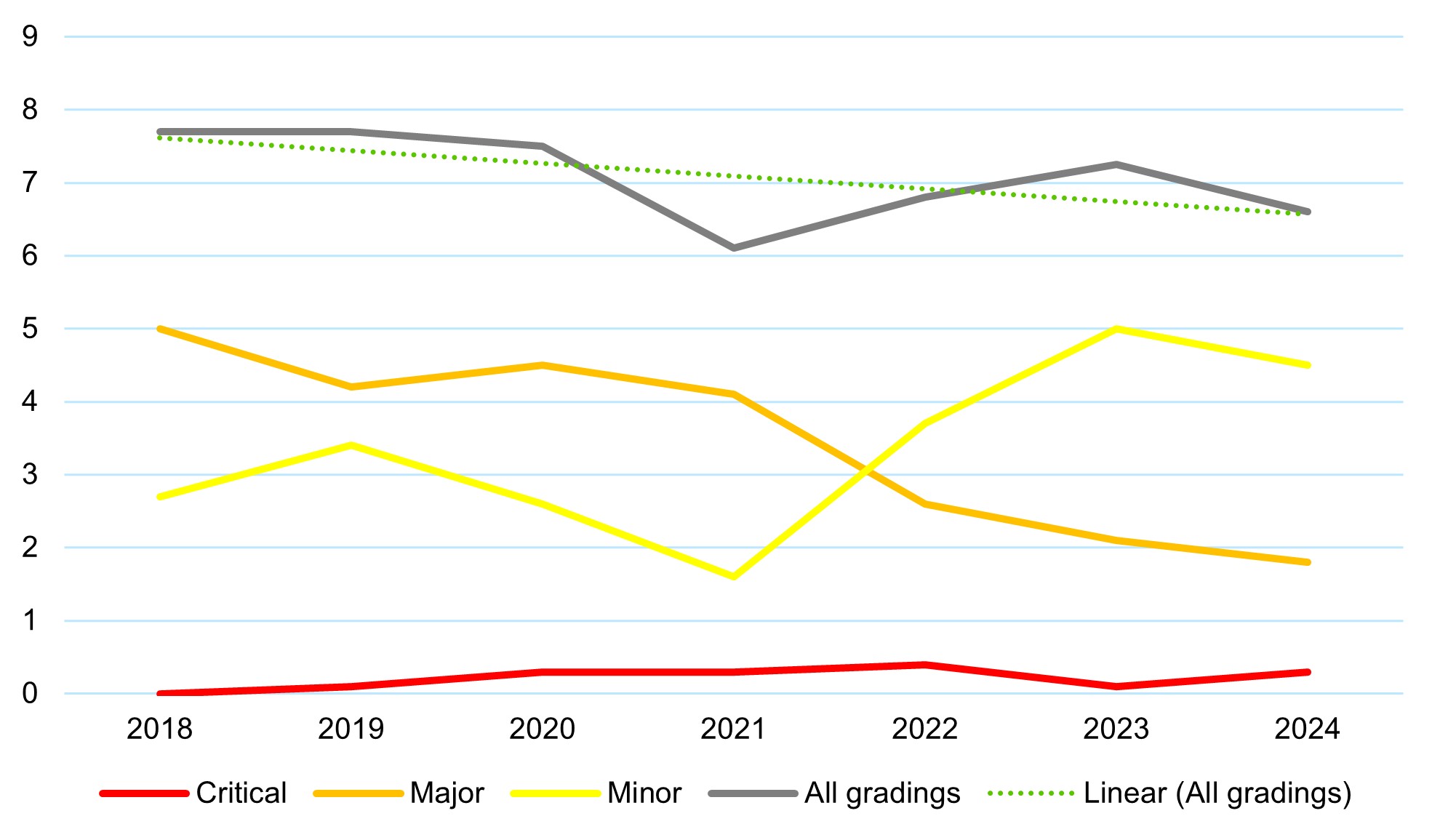
Figure 3. Average number of deficiencies per inspection 2018 - 2024
Figure 3. shows the average number of deficiencies per inspection from 2018 to 2024 across four categories.
Overall, total deficiencies (grey line) slightly decline over time, despite some fluctuations, with a noticeable drop in 2021 and a partial rebound afterward. Major deficiencies (orange) show a steady and significant decrease across the period. In contrast, minor deficiencies (yellow) fluctuate widely, falling to a low in 2021 before rising sharply to a peak in 2023 and easing slightly in 2024. Critical deficiencies (red) remain consistently very low throughout.
In summary, the data suggests overall improvement driven by fewer major issues, alongside a recent increase in minor issues.
Comparison of inspection deficiencies over time (2018 – 2024) continued
Overall, the average number of deficiencies per inspection, irrespective of grading, has slightly decreased overtime and for this two-year inspection reporting period of 2023 – 2024, the average number of deficiencies per inspection was 7, compared to 7.7 in 2018.
The average number of critical deficiencies per inspection has remained relatively constant over time, whereas a downward trend can be observed for the average number of major deficiencies per inspection and an upward trend for the average number of minor deficiencies per inspection.
The data suggests a sustained improvement in sponsor adherence to pharmacovigilance requirements and recommendations. Over time, both the frequency and severity of identified deficiencies have declined.
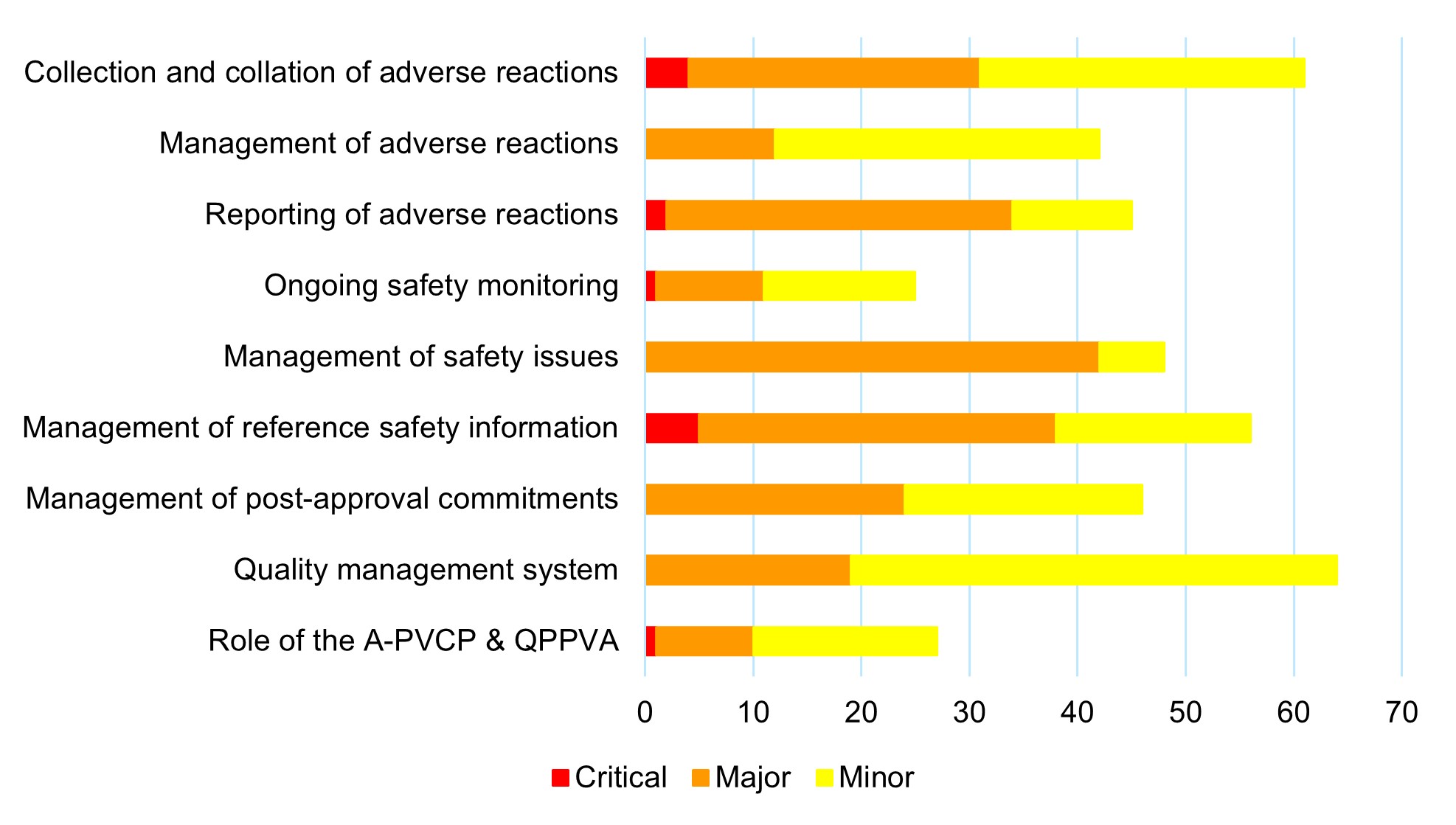
Since the commencement of the program in 2018 to the end of 2024, a total of 414 deficiencies were identified from 58 inspections. Figure 4 below shows the distribution and grading of these 414 deficiencies by topic area.
Figure 4. Number and grading of all deficiencies by topic area between 2018 - 2024
Figure 4 is a stacked horizontal bar chart showing the number of deficiencies by topic area, grouped into Critical (red), Major (orange), and Minor (yellow) categories.
Overall, minor deficiencies make up the largest portion in most topic areas, particularly in Quality management system and Collection and collation of adverse reactions, which have the highest total counts. Major deficiencies are also substantial across all areas, especially in Management of safety issues and Reporting of adverse reactions. Critical deficiencies are very low in all categories, appearing only as small segments.
The chart highlights that most deficiencies are minor or major, with critical issues being rare across all topic areas.
Comparison of inspection deficiencies over time (2018 – 2024) continued
The topic areas of Quality management system, Collection and collation of adverse reactions, and Management of reference safety information are associated with the highest number of deficiencies, regardless of grading, from all inspections conducted between 2018 - 2024 (Figure 4). This equates to 43.7% of all deficiencies. Most individual reporting periods since the commencement of the PVIP, have also demonstrated a similar pattern of deficiencies attributed to these 3 topic areas, highlighting a consistent and ongoing theme of non-compliance in these aspects of sponsor pharmacovigilance systems since 2018.
Of the 9 topic areas, Management of reference safety information is attributed with the most critical deficiencies (5) since the commencement of the PVIP which signifies a change from the cumulative data analysed up to 2022 in our previous metrics report, where Collection and collation of adverse reactions was the topic area with the most critical deficiencies attributed. All 5 critical deficiencies for the topic area Management of reference safety information were identified in inspections of generic and complementary medicine sponsors and mainly concerned systemic non-compliance with the maintenance of the PI or label with the current, required safety information.
The distribution of major and minor deficiencies across the 9 topic areas has remained relatively consistent since commencement of the PVIP.
Summary
Analysis of the average inspection deficiencies per inspection over a 7-year period since the commencement of the program in 2018, as presented in Figure 3, suggests a sustained improvement in sponsor adherence to pharmacovigilance requirements and recommendations. Over time, both the frequency and severity of identified deficiencies have declined. The latter driven by a decrease in the number of major deficiencies.
Whilst the number of critical deficiencies identified per reporting period has remained relatively constant over the 7-year period, this number has remained low and represents only 3% of total deficiencies identified through the PVIP.
Appendix I: Inspection topic areas
| Topic area | Aspects of the pharmacovigilance system reviewed |
|---|---|
| Collection and collation of adverse reactions | Collection of spontaneous sources of safety data, including medical information, product quality complaints, medical literature, company personnel, social and digital media etc. |
| Collection of solicited sources of safety data, including patient support and market research programs, post-registration studies etc. | |
| Collation of safety data to facilitate effective ongoing monitoring | |
| Management of adverse reactions | Case processing e.g. duplicate checks, data entry, quality control and assurance, coding, causality and seriousness assessment |
| Follow up, including use of targeted follow up questionnaires (if applicable) | |
| Management of invalid cases | |
| Management of special situation reports | |
| Reporting of adverse reactions | Reporting of initial and follow up serious adverse reaction reports to the TGA |
| Ongoing safety monitoring | Signal detection and assessment |
| Management of safety issues | Identification and receipt timeline of Significant Safety Issues and Other Safety Issues by the sponsor |
| Recording of assessment decision of safety issues as SSI and OSIs | |
| Reporting timeframes for SSI and OSIs | |
| Management of reference safety information | Maintenance of Australian PI, CMI, product packaging leaflets and product labelling (as applicable) |
| Maintenance of safety-related information in company-sponsored material (e.g., educational, or promotional items) | |
| Communication of updated safety-related information to internal and external stakeholders | |
| Management of post-approval commitments | Submission of PSURs |
| Maintenance and submission of RMPs/ASAs | |
| Compliance with RMP/ASA commitments | |
| Oversight of and compliance with other pharmacovigilance related conditions of registration | |
| Quality management system | Management and retention of pharmacovigilance records |
| Pharmacovigilance training | |
| Implementation and management of pharmacovigilance procedures | |
| Audit and deviation management | |
Implementation and maintenance of safety data exchange agreements, pharmacovigilance agreements and pharmacovigilance clauses in other agreements. Completeness of agreements and compliance with the agreed pharmacovigilance responsibilities. | |
| Oversight of third parties and vendors | |
| Role of the A-PVCP & QPPVA | Notification of the A-PVCP, including updates |
| QPPVA oversight of the pharmacovigilance system including involvement and awareness of product-specific issues |
Appendix II: Inspection deficiency gradings
Excerpt from the Pharmacovigilance inspection program: Guidance for medicine sponsors.
Critical deficiency:
A deficiency in pharmacovigilance systems, practices or processes that adversely affects the rights, safety or well-being of patients or that poses a potential risk to public health or that represents a serious violation of applicable legislation and guidelines.
Deficiencies classified as critical may include a pattern of deviations classified as major.
A critical deficiency also occurs when a sponsor is observed to have engaged in fraud, misrepresentation or falsification of data.
Major deficiency:
A deficiency in pharmacovigilance systems, practices or processes that could potentially adversely affect the rights, safety or well-being of patients or that could potentially pose a risk to public health or that represents a violation of applicable legislation and guidelines.
Deficiencies classified as major may include a pattern of deviations classified as minor.
Minor deficiency:
A deficiency in pharmacovigilance systems, practices or processes that would not be expected to adversely affect the rights, safety or well-being of patients.
A deficiency may be minor either because it is judged as minor or because there is insufficient information to classify it as major or critical.
Note:
Deficiencies are classified by the assessed risk level and may vary depending on the nature of medicine. In some circumstances an otherwise major deficiency may be categorised as critical.
A deficiency reported after a previous inspection and not corrected may be given higher classification.
Comments (observations) may be included in the inspection report and are not discussed here in this report. Comments are not deficiencies but might lead to suggestions on how to improve quality or reduce the potential for a deviation to occur in the future.