

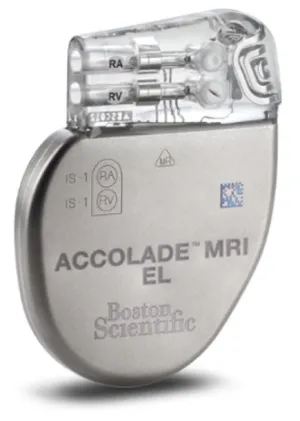
ACCOLADE single chamber (SR), dual chamber (DR) standard life (SL) and DR extended life (EL) pacemakers; and VISIONIST cardiac resynchronization therapy pacemakers (CRT-Ps)
This market action has been updated to include new information regarding the software correction, actions for healthcare professionals and inclusion of all CRT-P and dual-chamber extended life (DR-EL) devices. These updates follow on from the previous web statement published in December 2024. Further updates to this market action where published in April 2026.
As previously communicated in December 2024, Boston Scientific have advised that a subset of ACCOLADE single chamber (SR), dual chamber (DR) standard life (SL) and DR extended life (EL) pacemakers; and VISIONIST cardiac resynchronization therapy pacemakers (CRT-Ps) have an increased risk of permanently entering Safety Mode which has limited functionality.
Boston Scientific is now notifying healthcare professionals and patients that a software patch is available; however, two unintended behaviours have been identified that may occur when the software patch is implemented.
Affected model numbers
- L310
- L311
- L331
- U225
- U226
- U228
Product names
- ACCOLADE SR SL MRI
- ACCOLADE DR SL MRI
- ACCOLADE DR EL MRI
- VISIONIST CRT-P EL
- VISIONIST CRT-P EL MRI
What is the update?
Despite the possible occurrence of two unintended behaviours, Boston Scientific strongly recommends the installation of the software update for all devices to remediate the initial safety mode risk of devices permanently entering Safety Mode during telemetry or other normal, higher-power operations. The risk of devices permanently entering Safety Mode has been associated with the pacemaker failing to adequately regulate the heart’s rhythm and rate in some patients.
Since the release of the software update in August 2025, and following firmware updates delivered via the Model 3300 programmer, Boston Scientific has identified two unintended behaviours:
- Incomplete disablement of wandless automatic telemetry after detecting a high battery impedance condition, which continues the risk of a device entering safety mode unintentionally.
- Potential for the software’s new daily battery test to misinterpret measurements in the presence of a magnet, initiating a false positive response that results in permanent disablement of wandless telemetry sessions.
The ongoing risk of the device unintentionally entering safety mode is lower after receiving the patch.
During the behaviour where wandless telemetry is disabled, device sensing, therapy delivery, and all programmed functions remain unaffected.
Despite the possible occurrence of these unintended behaviours, Boston Scientific strongly recommends the continued installation of this software as the benefits of implementing the software outweigh the risks associated with prophylactic replacement.
What are the risks of entering safety mode?
Risks associated with this problem occurring include:
- Device replacement/surgery being required.
- Loss or pause of pacing activity that may result in death or serious injury in some patients not sufficiently treated by Safety Mode.
- Muscle stimulation.
- Heart failure.
What should patients do?
- Continue to have your device monitored, either remotely or through your existing in-office follow-up schedule.
- If monitoring indicates your device has entered Safety Mode, immediately contact your treating clinician for a review and to discuss management options.
- Also consult with your treating clinician if you:
- have new or worsening symptoms such as light-headedness, chest pain, shortness of breath, palpitations, dizziness or loss of consciousness
- have any questions about your device potentially entering Safety Mode or
- to determine the remaining battery life and whether or not the problem may affect you.
- Should you be experiencing symptoms and unable to contact your clinician we recommend attending your nearest healthcare facility for assessment.
What should health professionals do?
- If you have concerns or need assistance to upload the software update, contact your local Boston Scientific sales representative or call Technical Services (02 8063 8299) to arrange for your programmer’s software to be upgraded.
- Timeframe to upgrade pacemaker or CRT-P firmware:
- For patients at risk of harm due to Safety Mode: If longevity remaining is four (4) years or less OR will reach four (4) years or less before the next scheduled follow-up, promptly schedule an in-person follow-up.
- For all other patients: Schedule the next follow-up in-person.
- During the in-person follow-up, interrogate the device using a Model 3300 LATITUDE programmer installed with Model 3869 v2.04 software.
- Replace the device if it enters Safety Mode before receiving the software upgrade.
- Monitor patients for symptoms indicating device performance problems, such as light-headedness or loss of consciousness.
- Detailed information can be found in the customer letter supplied to clinicians who have implanted this device.
Boston Scientific will provide an update on the correction of these unexpected behaviours when available.
Reporting problems
Consumers and health professionals are encouraged to report problems with medical devices. Your report will contribute to our monitoring of these products. For more information see the TGA Incident Reporting and Investigation Scheme (IRIS).
We cannot give advice about an individual's medical condition. You are strongly encouraged to talk with a health professional if you are concerned about a possible adverse event associated with a medical device.