

Personalised medical devices
Information about how we regulate personalised medical devices. These include patient-matched medical devices, custom-made medical devices and adaptable medical devices.
Medical devices can be designed and manufactured, or modified, to suit a specific person. These devices are called personalised medical devices.
This page introduces the 3 types of personalised medical devices and their regulatory requirements. Detailed information about each topic, including practical examples from the dental and allied health sectors, can be found in the Resources and guidance section.
Definitions and examples
Personalised medical devices are medical devices that are designed and manufactured, or adapted/modified, to meet the needs of an individual.
We categorise personalised medical devices into 3 types:
- Adaptable medical devices
- Patient-matched medical devices (PMMDs)
- Custom-made medical devices (CMMDs)
Adaptable medical devices
Adaptable medical devices are personalised after they are manufactured.
They are modified, adapted or assembled to suit a specific individual. This is done in line with the manufacturer’s instructions.
Examples include:
- A limb prosthesis assembled from pre-manufactured components in line with the manufacturer’s instructions.
- An off-the-shelf bruxism mouthguard, to be moulded by the patient themselves.
- A prefabricated (non-prescription) orthotic insole, shaped and trimmed to the right size for a patient.
Patient-matched medical devices
Patient-matched medical devices (PMMDs) are personalised before they are manufactured.
They are manufactured to match the anatomical or physiological features, or pathological condition, of an individual. This is done within a specific design envelope, using production processes that can be validated and/or verified and reproduced.
Examples include:
- A dental aligner that is designed in a software suite to fit a specific person.
- A wrist splint that is designed and moulded to match a specific person’s anatomy.
- A maxillofacial plate that is designed and 3D-printed to suit an individual’s precise defect.
Design envelope
The design envelope is a set of parameters, within which the device can be tailored (matched) to a specific person, while ensuring the device:
- is safe,
- is fit for its intended purpose, and
- meets the intended recipient's needs.
These parameters (or factors) may include:
- minimum and maximum dimensions
- performance limits
- allowable environmental limits for operation
- specifications for materials and their properties.
Custom-made medical devices
Like a PMMD, a custom-made medical device (CMMD) is designed and made for a particular person. Unlike a PMMD, a CMMD is so rare and unique that the manufacturer cannot adequately and fully validate the design or production processes used. A health professional may determine that a CMMD is needed when no other device like it is included in the Australian Register of Therapeutic Goods (ARTG).
An example is an acetabular implant made for a person who is 2.26 metres tall and weighs 160 kilograms. The dimensions and tolerances of the implant needed to suit this person are outside the manufacturer’s usual design envelope. The implant is genuinely a ‘once-off’ and therefore is a CMMD.
Use the decision tree below to help you decide what type your medical device is.
Medical device decision tree
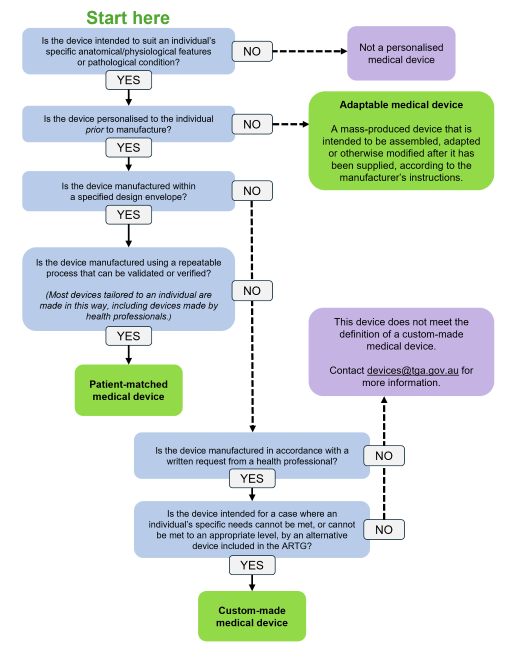

A decision tree flow chart for determining the type of personalised medical device.
Question 1. Is the device intended to suit an individual’s specific anatomo-physiological features or pathological condition?
- If yes: Proceed to the next question.
- If no: The device is not a personalised medical device.
Question 2. Is the device personalised to the individual prior to manufacture?
- If yes: Proceed to the next question.
- If no: The device is an adaptable medical device. This is a mass-produced device that is intended to be assembled, adapted, or otherwise modified after it has been supplied, according to the manufacturer’s instructions.
Question 3: Is the device manufactured within a specified design envelope?
- If yes: Proceed to the next question.
- If no: Proceed to the question 5.
Question 4: Is the device manufactured using a repeatable process that can be validated or verified?
- If yes: The device is a patient-matched medical device.
- If no: Proceed to the next question.
Question 5: Is the device manufactured as a result of a written request from a health professional?
- If yes: Proceed to the next question.
- If no: This device does not meet the definition of a custom-made medical device. Contact devices@tga.gov.au for more information.
Question 6: Is the device intended for a case where an individual’s specific needs cannot be met, or cannot be met to an appropriate level, by an alternative device included in the ARTG?
- If yes: The device is a custom-made medical device.
- If no: This device does not meet the definition of a custom-made medical device. Contact devices@tga.gov.au for more information.
Patient-matched medical devices
PMMDs are currently exempt from inclusion in the ARTG until 1 July 2029. They can be manufactured and/or supplied until then under this exemption.
Note:
Exempt devices are exempt from inclusion in the ARTG. They are not exempt from regulation. If you make or supply an exempt medical device, you still have to comply with TGA regulations, such as:
- Meeting all relevant Essential Principles This includes supplying the device with adequate labelling and instructions for use;
- Meeting advertising requirements for therapeutic goods.
After 1 July 2029, all PMMDs must be included in the ARTG. You will need to do this before you import, supply, or export them, unless they are exempt, excluded or otherwise approved by us.
Two exemptions are ongoing. If you meet the criteria, you can access these exemptions even after 1 July 2029:
- Low volume exemption: The first 5 of a ‘kind ’ of a PMMD supplied in a financial year by one entity are exempt from ARTG inclusion.
This means you can make, supply, import or export up to 5 of a kind of a PMMD per financial year without including it in the ARTG. - Specified articles exemption: If a PMMD is made exclusively from specified articles by a health professional or to a health professional’s written instructions, the finished device is exempt from ARTG inclusion.
Custom-made medical devices
CMMDs are exempt from inclusion in the ARTG. They are not exempt from regulation by us.
If you make or supply a CMMD, you have regulatory obligations, including:
- notifying us
- providing an annual report to us
- following inspection and review conditions.
Resources and guidance
| Title | Description |
| Understanding regulatory basics on medical devices for health practitioners | Guidance to help health practitioners identify:
|
| Understanding personalised medical devices rules (including 3D-printed devices) | Guidance and examples to help you understand the regulatory framework for personalised medical devices. |
| Understanding specified articles and excluded products in personalised medical devices regulation | Information for manufacturers and sponsors of personalised medical devices, including health professionals. Learn what we mean by ‘specified articles’ and the difference between exempt vs excluded products. |
| Meeting 3D printing (additive manufacturing) rules for medical devices | Guidance to help manufacturers (including health professionals) manage risks and meet regulatory requirements. |
| Advertising personalised medical devices | Examples to help you understand the rules for advertising therapeutic goods to consumers. |
| Understanding regulation of custom-made medical devices | Information for manufacturers, sponsors and health professionals on the definition of a custom-made medical device and how we regulate them. |
| Guidance for dental practitioners | Information on regulatory requirements for Ahpra-registered dental practitioners making and adapting personalised medical devices. |
| Medical devices reforms: Personalised medical devices | Project overview of regulatory refinements to personalised medical devices, including consultations. |
| Point-of care manufacturing of medical devices | Project overview and details on how we engage with stakeholders. |
Contact us
For questions about medical devices and their regulation, contact devices@tga.gov.au
For issues with the TBS portal and/or accessing the custom-made medical devices notification form, contact the TGA Business Services (TBS) Helpdesk on 1800 010 624, or +61 2 6232 8888 or email ebs@tga.gov.au
You can also send an email to devices@tga.gov.au with ‘SUBSCRIBE PMD’ in the subject line to receive:
- notifications when guidance documents and other information resources are published
- updates about the regulatory framework
- details about webinars and workshops.
Page history
Added content and sections to form a comprehensive landing page.
Revised page structure to improve flow and readability.
Added a new 'resource and guidance' table to host all related documents.
Original publication.
Added content and sections to form a comprehensive landing page.
Revised page structure to improve flow and readability.
Added a new 'resource and guidance' table to host all related documents.
Original publication.